Episode 11 - Colin Wansbrough
24 June 2020 · Steve Prior
Listen to this episode ·
Subscribe in Apple Podcasts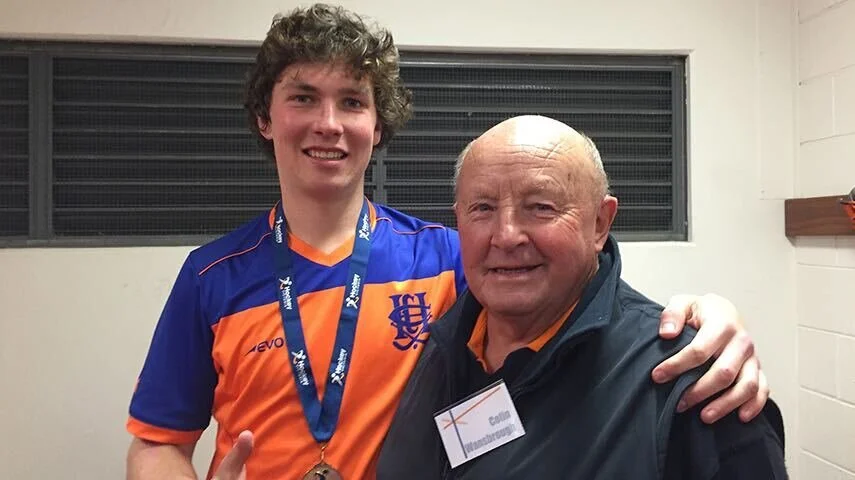
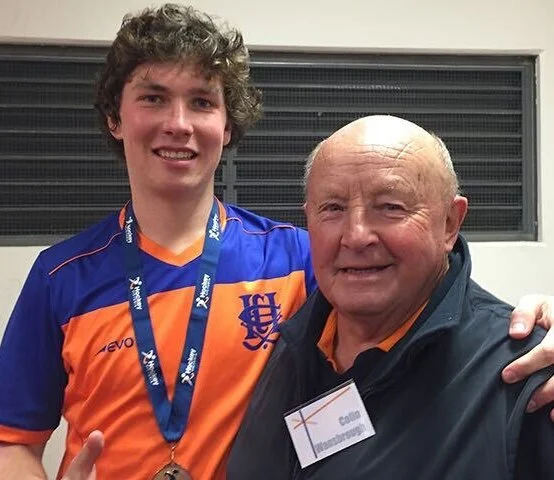
Max Harris and Colin Wansbrough
Life member Colin Wansbrough joined the club in 1949, just 17 years after its establishment and proved to be a pivotal figure in Australian hockey. Colin Morley, son of coaching legend Charlie has said “I also credit [Col] as a key, if not the key antagonist in rescuing Camberwell from sliding into mediocrity back in the 1970’s”
Hear how Col arrived at the club and what it and Victorian hockey was like in those days and how the modern game has changed. Find out about the incredible group of the ’50s who appeared in over a dozen straight grand finals and the dark times of the relegation in the ’70s.
Col recounts his work in Victorian and Australian hockey administration, traveling the work as a tournament director and discusses his role in the formation of what has become the masters competition.
Episode transcript
⚠️ Automated transcript
This transcript was generated automatically from the episode audio and lightly corrected. It may still contain transcription errors, and individual speakers are not labelled.
In the 1950s, Camberwell, under legendary coach Charlie Morley, played an attacking, short-passing hockey with Indian-style sticks that was years ahead of its time. The club appeared in almost every single grand final between 1945 and 1960. In the 1980s, as you’ve heard in previous episodes, Camberwell, with Waverley Hockey Club, dominated the competition, sharing alternate premierships for almost the entire decade. In the 1970s, though, the club faltered. A generation of players retired, our junior base was poor, and in 1972 we were relegated from the First Division. The man we’re about to meet — life member, past president and patron of the club — is credited as being a key figure in preventing our slide into mediocrity and establishing the foundations of the strengths and culture we enjoy today. Welcome to the Camberwell Hockey Podcast.
This week, Max Harris joins the hosting team to present Colin Wansbrough, a club legend and pivotal figure in Australian hockey. Just a note: the audio quality on Max’s side is not ideal in this episode, but the story is compelling and well worth a listen. Here’s Max. G’day, I’m Max Harris and I’m here with a patron of Camberwell Hockey Club, Colin Wansbrough, who also happens to be my grandpa. Colin has been involved as a player, coach, selector, president, life member and now spectator at Camberwell for many years. Thanks for doing the podcast, Colin.
Now, I’ve promised to keep this under an hour for the listeners. Do you think we can manage that? I think I can manage that, but it’ll be a difficult task. Well, first off, how did you come to be involved in hockey, and can you shed some light on Camberwell’s early days? Well, I belonged to the first Camberwell Scouts when I was 13, which was 1949, and a friend at the Scouts asked me what I was doing the next morning. He said, if I wasn’t doing anything else, to come down and have a game of practice hockey.
And I went down, and I started playing junior hockey in 1949 from that point on. And in those days, there was only an under-16 age group for junior players. There was no other staggered ages like under-10, 12 or 14. So from that moment on, I played three years of junior hockey until 1952, when I made my debut in the senior ranks. And I played until 1990 in matches. I played Premier League — the equivalent of Premier League now — between 1952 and 1965, and then I played in the lower grades and did some coaching then, and eventually finished up playing veterans hockey until 1990.
So, did anyone else in your family play hockey? Was there any influence from parents or friends? Well, the main influence I had — I didn’t realise it when I started — was that the Camberwell Club was coached by Charlie Morley, who was an institution in hockey. At that time, he was the Camberwell coach, he was the Victorian coach, and he was the Australian coach. And so we happened to be settled in a club that had the Australian coach in charge, and I was extremely fortunate, because he was a strict disciplinarian. He was ahead of his time with tactics, and Camberwell were the leading club, unbeknownst to me, in the Melbourne League.
Camberwell, I think, had played in every grand final between 1945 and 1960, winning about half of them. And then we had to face up to the fact that we had only three junior teams, and the talent fell away as people retired. And so the club then had to struggle somewhat into the ’70s, until for one year it was actually relegated from the top league, in I think 1972. But we were able to retain our players, won that second division competition, and were reinstated into Premier League the following year. And ever since then, the club has gone from strength to strength. If you could maybe elaborate on some of the grades of hockey that you played, from Camberwell to Victoria and to Australia,
and where you found the most success or enjoyment? And specifically, can you share any memories of a 1950s playing group? When I played in 1952, I think the first time that I was involved in the finals was 1955. We played, and I played in three successful premiership teams, between 1956, 1958 and 1959. And they were wonderful occasions. But unlike in today’s era, we celebrated our grand final win by having a cup of tea and cake at Charlie Morley’s place that evening, and we were home by 10 o’clock, in bed. He was a strict teetotaller, I’ve heard.
He was. He was probably the equivalent in hockey to Harry Hopman in tennis, and probably Jock McHale, the great coach at Collingwood. He was a very influential person, in the fact that of the Camberwell team that I was involved with, people such as Mike Craig and Ric Purser, to name a couple, have gone on to make major contributions to Victorian and even Australian hockey — all as a result of the training that they had under Charlie Morley. I think, as far as other achievements by the Camberwell Club, looking back on those early days, we only had two junior teams, two under-16 teams, and that wasn’t enough to feed in continuing new talent.
And so I think in today’s era, there are something like 27 junior teams, apart from Minkey hockey players. So there was a continuing stream of people rising up through the ranks, and the coaching is so highly organised, and the administration of the club is so highly organised today, that it runs almost like a business. Whereas in the old days, it was quite different. Charlie Morley had three senior teams. Charlie Morley only coached the top side. He would actually insist on every player having clean, polished boots and white laces before they took the ground, otherwise they wouldn’t play. You almost had to have creases in your shorts before you could play. And he would ring up on Friday nights at 8 o’clock to make sure that we were all in bed asleep before my match.
Most of the time I would be out at the pictures on Friday night with some of my friends, and my mother would answer that I was fast asleep in bed. That’s great. Can you touch on the Victorian teams you played in? I played in Victorian teams initially in under-21. It was called the Colts team. And the under-21 side did have a national championship each year. I was selected in 1954 when I was 18. I managed to actually hit a goal, which I miss-hit and trickled into the corner of the net, and scored the first goal in the first match.
We can’t forget that one. I then captained the under-21 team to Perth the following year, in 1955, in which case I met my bride-to-be on that particular trip, and so that was pretty memorable also. That was to Western Australia. The next year I captained the under-21 team to Hobart. They played the national championships in Hobart. That was, I think, in July or August. And in that year, 1956, was the Olympic Games. And that happened to be the first year that Australia actually played in an Olympic tournament.
They had not participated prior to that. So there was great excitement, as everybody wanted to be picked in the Australian team. Following the Colts under-21 tournament in July, I was chosen, with one other person, John Purser, to play in the Victorian senior team, which took place, I think, in October, from which championship they picked the Australian team. So that was actually, I think, the first time anybody in under-21s had actually played in the senior team. From that, I played in 1957 in Adelaide and 1958 in Perth again, on which occasion I became engaged to Jenny while we were over there on the trip. So the team, even though we got smashed 5-0 by Western Australia in the first match, with five Pearce brothers playing, still managed to celebrate my engagement later on.
We finished second. We never, ever won a national championship in my time, but we came second a few times. Then I had a slight break. I played for Victoria in some matches against a visiting Indian team in between, but I didn’t resume playing in the interstate national championships until 1962, which was held in Adelaide, and 1963, which was held in Melbourne. And after that, I did not play any further interstate hockey.
You must have had some talent, then, but from what I’ve heard you were quite a rough, bullish player. Could you maybe tell us how you would define your playing style? Well, I was very proud. I think — well, what some people say — I did win our best and fairest in the Melbourne competition in 1958. So I must have made some good passes to the people that counted.
I gave my all on the field. I was a very determined player. I wasn’t maybe the most skilful player in terms of stick work and those particular aspects, but I was pretty good with my passing and my reading of the game. And I was also very, very fortunate to play in a team that was full of very good players: Mike Craig and Ric Purser and John Purser and Alan Carnell and Bill Horman and Ron Legg, Ken Burkett, Graham Wood. A shout-out there to the oldies.
A few people went on to play for Australia. So we actually had, at one stage, I think, seven or eight of the Camberwell team form the Victorian state team. So we practically were the dominant club for all those years. A lot of those players made you look good? They probably did. They probably did. Or, alternatively, I probably made them. Okay. Either way.
Now, there is a story you’ve told me, and this is good for the young ones. Can you tell me how you travelled to Western Australia for the hockey tournaments? On the first trip we made in 1955, the under-21s, the team could only afford — the Victorian Hockey Association only sent a manager, because of the cost — and we travelled by train. We left Melbourne in the evening, and we arrived in Perth three days later. It was a two-and-a-half-day train trip across the Nullarbor.
We changed trains four times. We travelled on four trains to make that journey. So it took two and a half days to get there. And because there was no coach of the team — Charlie Morley had coached us prior to leaving Melbourne — once we set foot on the train, I automatically became the captain-coach of the team, and we had coaching sessions in the mornings and the afternoons on the train, with a board and draught movements to check out all our tactics, etc. So for any young ones out there, I think that shines a bit of perspective on what people had to go through 50 years ago.
So it’s a great story. So, back to Camberwell: what roles have you held within Camberwell Hockey Club, and how have you found the transition between each role? Well, I joined the committee, I think — as a senior, as I said before, I started in 1952. In 1960, I think, I was elected to a place on the committee of the club. Charlie Morley always insisted that people made a contribution. And in 1961 I became the club secretary. And from that moment, I became a member of the committee constantly through until, I think, 1995. So I think I was on the committee for something like 35 years.
In that transition — now, I have to say, we went through tough times and a lot of work, and we had a lot of negotiations with the council, who were very cooperative. It was the Camberwell Council then, prior to becoming Boroondara, and we had a good relationship. The ground went through a stage where we arranged for the transformation of the Matlock Park ground, from what was originally a cinder ash surface to then a porous red scoria gravel surface. And then in 1986 we laid the first astroturf pitch, and I had a very deep involvement in negotiating all that, building of that, with the council and with the contractors and with other committee members too.
But that was our major project. And at the same time — after the club had existed with a little corrugated iron shed on the western boundary of the club, where the team shelters are now — we had a single shed there, which was all-inclusive. It had a toilet in the corner. It had one shower next to the toilet. Sometimes the sprays mixed up with each other. And it was men only, because there were no female facilities. So wives, mothers, girlfriends had to have big bladders and stay in the car and watch the match, because they couldn’t use the facilities.
So my other main achievement, I suppose, at the time was the overseeing of the commissioning of the first pavilion, in 1986, at the time when we laid the astroturf. And we built a fully fledged pavilion there, which had two changing rooms and two smaller rooms for selection and property, which we promptly made into a social room and kiosk. And then subsequently, in 1995, we amalgamated the women’s section of the club with the men’s section, and rebuilt the pavilion to accommodate the female teams in the club — the women’s club — and it all became one. And that was the premises that existed until last year, 2019, when the new, wonderful pavilion was newly constructed at Matlock Park. That’s amazing to see, because Camberwell is one of the biggest clubs in Australia.
Huge membership population, I guess, and growth of the club. Yeah, it’s amazing to see — that the club wasn’t as, well, amazing as it is now, I guess. Was there any time, sort of through the ’70s or ’80s, where the club was maybe really struggling financially, or where there was a dire strait, you’d say, for the club? We did go through a period when our playing power dropped. And for that year when we were relegated, we did find that a lot of players had retired from playing, and then the interest had dropped away, and we realised that we had to do something to resurrect the club at that stage.
We were on shaky ground and we went through a pretty tough time. But one thing that I felt helped was co-opting Keith Thornton to come out of retirement and take an active interest in the club, and he became president following the retirement of Rex Allind. Keith steered the club up through the ’70s and through the ’80s, and we started building — deliberately building — the youth section of the club, and by that time we had under-10, under-12, under-14, under-16 age groups, and we had a new crop of players, some of whom were children of players of my era. They eventually came through the ranks of the juniors and rebuilt the strength of the club.
So it probably took most of the ’70s to transform the club from what had been a power to a struggling club, and then it got back on its feet and became a forerunner in the Victorian Hockey Association. I might add — I think what has happened now, over the last 20 years, with the administration of the club, is absolutely a source of great joy and comfort, because the club has done more to help so many players of whatever ability. And now it is a wonderful club, inclusive of juniors, seniors, veterans, male, female, whatever it is, and the facilities that are provided and the administration of the club — I’ve got nothing but praise, because I think it is just a wonderful tribute, to now offer the opportunity into the future.
Perhaps the only regret is that we are limited to one particular playing surface down there, which — it would have been nice had we been successful in getting a greater area. You couldn’t do it all, but you did a lot. Next up: how have you seen the development of the Veterans Programme? I know you’ve been heavily involved in its beginnings. So, yeah, how did that arise, and what involvement did you have? There was a very important hockey carnival held — conducted every Easter at Albury — and it was quite famous.
I think at one stage it was probably the biggest hockey club participation in the world, with something like more than 200 teams playing. When I finished playing senior hockey, probably around about the early 1970s, for about 10 years I organised — it was just an initiative that I was prepared to take on — I got in touch with various prominent players who had played hockey during my time, and even after that: people of the ilk of Des Pyre and Chicken Howell and Robin Hodder, to name a few, apart from other Camberwell players, and Alan Berry from Essendon and Ross Preen and various other people who had played.
And we called it the President’s Eleven, and it was just one that I probably selected. I actually gathered — wrote to all these people and asked them if they would like to come back and just play in a social manner. And so we had some of these previous prominent players play together in the President’s Eleven until, I think — I remember in 1979 it was the 25th anniversary of the Albury Carnival, and we had special shirts printed for that occasion. And it became known, almost from that moment — in a sense, it was a forerunner of veterans hockey, because all these prominent people went back to their clubs and started recruiting other people who had played over many years. And Alan Berry and myself, in conjunction with Dennis Mulder, the Executive Director of Hockey in Victoria — we were then involved at the Victorian administration level in those days, and we thought that we were ready for a veterans competition to start.
And that did start, I think, from memory, about 1978, ‘79, ‘80. Was there anything like that before? Nothing like that before. And we did that, and from that, in 1980, it started — the trend had started also in the other states, and so… In 1980, Western Australia conducted the first Veterans National Championship, which we attended. We had 12 players only, including the manager of hockey in Victoria, Dennis Morgan, who’d been a rugby player, but we co-opted two or three Western Australians to do the running for us, and we had a very good social time — including sailing down the Swan River after our match and having a few little stubbies.
Now the competition is highly organised, in different age groups, and it’s become more successful. When it started, it was really a chance to have a second go at putting your boots on again and having a run with old friends in a happy environment. That’s right. It’s prolonged a lot of playing careers, so it’s been a brilliant initiative. From your perspective, how has the game itself, I guess technically — how has it changed, from a playing perspective and also from an administrative viewpoint?
Well, it has changed dramatically, and for the better. When I played at the top level, we played mostly — certainly in Melbourne, mostly on football grounds, which often might have had a fairly gloomy wicket in the middle of them, which made it pretty hard with a hockey ball. And we played on grass grounds. It was different in other states, because in Western Australia we played a national championship on the WACA, and it was, I think, either couch or buffalo grass, but it was just a perfect surface, like a bowling green, and we’d never struck anything like that before.
So we played in different conditions in Melbourne. So the changes that I’ve seen — probably the most obvious one is going to an artificial turf surface, both a sand-filled surface at the club level and the proper, pure astroturf surfaces at the higher levels. That, for a start, made the hockey much easier to play, and you had to be more precise and more skilful. I think, the fact that we were able to play on those surfaces, they also then brought in two or three rules at the international hockey level.
Firstly, to basically cut out offside. It was very, very much stop-and-start and whistle-happy when I played. It was a bit more like rugby. There was no flow to the game, really, unless it was a tight contest. But with the changes in the rules, they then amended the obstruction rules, so that the player with the ball could turn without blocking with his body — but it is almost like ballet dancing now, compared to what it was before, and the obstruction rule stopped it.
Also, moving with the ball from a free hit changed. You couldn’t do that. You had to roll the ball in from the sideline, and you didn’t hit it. And certainly when you took a free hit, you were stationary when that happened. So now the changes to the game have been so progressive that it’s turned into an exciting game — basically no offside, no obstruction, the ball moves all the time. The players’ individual skill level is a thousand times better than it was when I played. So it is just a delight to watch.
It’s exciting, and I think they’ve done everything — which is pretty unusual, sometimes, when real changes are made from the higher level without necessarily understanding the game. And I think they’ve done it properly, and it’s certainly helped enormously. So it’s all for the better. Equipment-wise, players now have hockey sticks with hooks on the end, and some of the holes in the stick, all range of adjustments to the stick. Now, I’ve heard that you used to have razors on the end of the stick and a titanium end, to give people a shove in the ribs.
Can you confirm that? And if not, what stick work? I’ve never heard anything like that — that I would use anything other than pure skill and artistry and body work. Sometimes the wind blew very strongly and blew people over when in my presence, but that’s only a mystery to me.
Incidentally, the hockey sticks overall, when I first played — they called it the Indian type stick, which had a tight little hook, like a shepherd’s crook, at the end, whereas the English type stick had a broad sweep curve, and a longer curve. It wasn’t tight at all. And so the English stick was probably better to just hit the ball hard with, when you’re hitting off a cow pat, but the Indian one was more appropriate for ball control. And Charlie Morley had taught the Camberwell team to use an Indian-style game, which was short passing, good stick work, and looking ahead and making a series of passes that had a purpose in them.
He had certain set moves that he instructed, whereas most of the teams in those days just hit and hoped. So the hockey stick had a bit to do with it. But now, with the improvisation, I think they made a fibreglass — it’s a composite material.
And originally they were made with a mulberry head — a wooden stick, wooden head with a cane handle, which was spliced just like a cricket bat and wound with string around that. It was suggested that some of the big fullbacks — each team had a major fullback in my very early days — it was suggested that they had their sticks taped at the bottom, and they thought that there were some lead weights in the bottom of them, which helped them sometimes hit the ball further, and also make these dents in shins. But I didn’t have one.
How did you then get involved in international hockey, and what was it like to travel to serve as a technical officer and tournament director? And what changes have you seen from the administrative side? Well, that’s pretty hard to answer within the 40-minute period. But let me just say — to get involved at international level, we had to be involved at national and state level. And in my case, when I was 21, I had just finished a commerce degree, but I hadn’t actually worked in a proper accountant’s office. And Charlie Morley suggested — or didn’t suggest, he just told me — that I had to take over as treasurer of the Victorian Hockey Association, which I did in 1957.
And I did that. And then, even through getting married and having young children, I still had to work on the Victorian hockey finances for some time, which I did for something like six years. And I was involved on the administration, the main council of Victorian hockey. And then that period had a gap, as our family grew up. And then I resumed a position with the Victorian administration in the mid-1970s, and I became a vice-president of Victoria, and I then became president of Victorian hockey, from 1977, ‘78, ‘79.
And then I became Victoria’s delegate to the Australian Hockey Association, so I attended Hockey Australia Council meetings. And I did that continuously until 1984, when I was then appointed Honorary Treasurer of the Australian Hockey Association. And I worked with Harry Netavine as president, Frank Gean as president and Peter Cohen as president in Australian hockey. And as treasurer, I was responsible for the finance committee, which included Don Argus and Bruce Morley and Tony Thornton. And as a result of being involved in Australian hockey, we successfully ran some international tournaments, which I was heavily involved in — the organising committee in 1982 and in 1990 in Melbourne — and meeting people from overseas.
I was, I think, nominated in 1985 as a judge, to participate at an international tournament as what they call a judge — a member of the jury — and we went to Germany. And from there, from being a judge or a technical official, I then became appointed as a tournament director, and I was able to finish up being able to travel to most continents. I officiated in Germany, Holland, Ireland, England, New Zealand, Malaysia. Do you have any memorable stories from those times or locations? Yeah, well, going to Pakistan twice was interesting. Being in a country where alcohol was forbidden — I remember in Pakistan, the entire Australian team managed to smuggle through customs quite a bit of useful drinking material, which was usually concealed in innocent cartons of some sort. And it didn’t matter very much, because all the customs officials in Pakistan were either past hockey or cricket players, and they let all sports teams in anyway.
So, yeah — it was just so interesting to see the difference in culture of all these different countries. But the one thing that was binding and bonding everybody together was their love of hockey, and they’re all like a big hockey family. Wherever you go — I’ve made many, many friends in many countries, and I’m still in contact with quite a few. So that was a learning experience. And, of course, I had some technical duties in a couple of tournaments in Australia as well. So hockey’s been very kind to me.
And I think, no matter what — no matter how much you put into it, you certainly get far more out of it. That’s very true. Which players have you loved watching, and why — in the modern game and also in the past? And who’s been the greatest influence of your career? We’ll start with who you enjoyed watching. Well, probably it goes without saying, the players I like watching most have been members of my family and my grandchildren. But apart from that, I’ve had the good fortune to see the great Ric Charlesworth play.
I’ve seen Terry Walsh and Jamie Dwyer — many, many players that I can’t name here. But also the greats that played for overseas: some of the great players in Holland, like Ties Kruize and Bovelander, who hit penalty corners. I think Bovelander, in the World Cup in Pakistan, when Holland played Pakistan in the grand final of that tournament — they were supposed to be evenly matched. There was no score up until about five minutes before halftime, and then Holland were awarded a penalty corner. Bovelander moved up, smashed the ball in. Two minutes later Bovelander got another penalty corner; the Pakistan goalkeeper went behind the net, right behind the goals, to hide from him, and he scored again. And a minute after half-time Bovelander scored again — I don’t think there was anybody in the goal mouth trying to defend — and so the crowd all dispersed, and Holland ran away easy.
Apart from that, there were wonderful players like Shahbaz in Pakistan; there was another wonderful captain of Pakistan who’d been captain and won gold medals, and he became the manager of the team, and I became very friendly with him. I think even Sean Kerly, who played as centre forward for England, was another great player. Germany had some wonderful players that I was lucky to be able to witness. And, of course, in Australia, as I said, Ric Charlesworth, Jamie Dwyer, Mark Hager, so many people. Charlie Morley, automatically. Mike Craig has probably been one of the great influential players, not only to me but to hockey generally.
He’s made an enormous contribution, and probably had the most effect on me — well, in thinking intellectually about the game, and not only how you deal in coaching and player development, but also in which way the game’s heading and how the club should be managed, and put on much more like a business-type board of management, rather than the old days when somebody’s elected secretary and treasurer and property steward, et cetera. Mike’s a deep thinker in the game. And I think there’s so many people, in many ways — but Morley and Craig would be two, apart from the other people like Alan Carnell and Bill Horman, et cetera, who have been friends.
But I think, in terms of the deeper involvement with the game, Mike Craig was probably more concentrating on individual performance skills — individual skills and things — whereas Charlie Morley was probably more a tactical coach, and didn’t worry so much about the personal skill levels, to the degree that Mike did. From someone who’s seen nearly 60, 70 years of hockey — where do you see the game that is now, and how do you think it’s changed into the future? The changes to hockey have just been dramatic in my lifetime.
I simply can’t see how hockey can improve on what it’s doing now. It seems to keep on being faster and cleverer, and people almost don’t hit the ball now — it’s mainly slap shots or pushes or whatever, but it’s all so quick. And I just can’t see anybody… The aerobic fitness of players now has so dramatically changed. They’re in the play so much more than they ever were. I honestly can’t foresee it getting any better, unless it’s played on virtual reality on a TV screen. Well, that might be the way. But the equipment has changed in my time, and I don’t see the change there.
The surfaces have changed, and the rules have changed, and the players’ fitness has changed, and the skill level’s changed. It seems to me that that’s almost out of peace. Yes, it’s a great game to watch, and, yeah, hopefully it gets more traction into the future. Now, lastly — we’ve just been to the Hockey Australia life membership the last month. That’s the culmination of a lifetime’s work in hockey. What does that mean to you? And be as boastful as you want.
Well, it did honestly come as a complete shock. I understand — I’m deeply humbled, and I’m very, very proud. I think that’s a wonderful recognition to me, but it really just reflects what other people have done for me, and I’ve tried to put a bit back into the game. I guess, when you think back, you do it because you love doing it, and you get so much pleasure out of doing it, that you don’t expect any reward from it. And for somebody to recognise that I’ve made some contribution — I guess my father once said to me, just while you’re on the wheel for a little while, just try and make it a better place than when you came to it.
And hopefully, if that applies to hockey — then if I’ve made some contribution, and other people can learn from that and gain from that, and then get some enjoyment from it, then I’ll be amply rewarded, I think. I regard it as a great honour, and it sort of sets the seal on probably 71 years of association with the game, which I love dearly. Right. And lastly — what does Camberwell Hockey Club mean to you? You know, you’ve been involved so long.
There’s so much history in the club. Simply put, what is it? Camberwell Hockey Club has been so much part of my life, and I’ve tried to influence all my family to take advantage of that and get as much enjoyment out of it as I have. I joined in 1949. The club was formed in 1932. So, without me realising it, it was only 17 years in formation prior to me arriving. It’s now 88 years old, and coming up to its centenary.
So that’s a pretty amazing achievement for a sporting club — to be in existence and continue on successfully for nearly 100 years. That is quite an achievement, and it’s been done through the efforts of hundreds and hundreds of people. There’s so many that I can’t name here, but without that help and that volunteer contribution… And they do it, too, for the same reasons I’ve done it: for the love of it. And Camberwell Hockey Club has just been so important to me.
As a 13-year-old, I used to take the hockey stick to bed with me at night, where other people took toys. And I haven’t changed very much — only, it’s a weapon now, in case a burglar comes. However, it’s given me great joy personally, because I’ve seen my children get so much pleasure and enjoyment and satisfaction from it, and they’ve all put back into the game likewise, from seeing the desire to do that. And now I’ve been fortunate enough to see my grandchildren do that also, and I just hope that they get as much pleasure out of it as I’ve had — because the bonding and the teamwork and the camaraderie that exists, especially in an amateur sport, makes it a great joy to be part of a team, and to share the memories and the highs and the lows that you get through the games.
So it’s been very, very much a part of my life. And I should say, finally, that without any ado, I wouldn’t have even been able to do anything like this without the help and support of my dearly beloved wife, Jenny, whom I met through hockey, and who’s put up with me being a hockey widow for many years, until I then became a golf widower. So I do pay tribute to her. We’ve hosted hockey meetings and been part of it, and we’ve travelled together and got great pleasure in our hockey travels.
So it’s been the world to me.