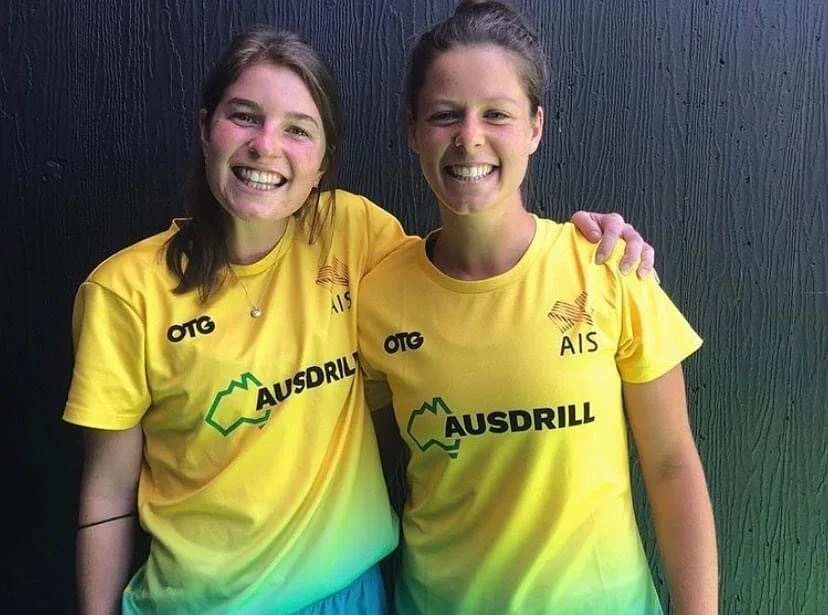
Episode 2 - Laura Barden & Sophie Taylor
23 April 2020 · Steve Prior
Listen to this episode ·
Subscribe in Apple PodcastsDavid Wansbrough joins our hosting team to present Hockeyroos champions Laura Barden & Sophie Taylor.
Conversation includes the suspension of the High Performance program, training at home and the challenges of competitive selection with a delayed Olympic cycle.
The girls recall the early days at Camberwell Hockey Club and the benefit of the tight-knot Victoria Vipers culture; and explore the physical and mental demands of the HP program, dealing with selection setbacks and discus how they approach their games.
Episode transcript
⚠️ Automated transcript
This transcript was generated automatically from the episode audio and lightly corrected. It may still contain transcription errors, and individual speakers are not labelled.
Over the past few years, three players and a coach from the club have gone on to represent the Hockeyroos. Wansey speaks to two of the girls next. Welcome to the Camberwell Hockey Podcast. Laura Barden and Sophie Taylor played all their junior careers at the club, went on to play seniors, State League One and Premier League, before breaking into the Hockeyroos team. Club legend and hockey superstar David Wansbrough joins our hosting team and speaks to the girls next. Welcome tonight.
It’s fantastic. Really exciting to have a couple of our female stars from the Camberwell Hockey Club who have been in Perth of recent times with the Australian program preparing for the Tokyo Olympics in July. Obviously, with the corona situation, they’ve had to come back here, and they’re able to get back to their families and homes and to reset, I guess, until the coast is clear. But really exciting to have a couple of young ladies that have come all the way through the club, started as juniors and have gone on to some great things at the highest level.
So welcome, Sophie Taylor, and welcome, Laura Barden. Just tell us what has happened. You came back from Perth in the last few weeks. What’s been the upheaval in the process? Yeah, so our program got shut down, I guess once all the gyms got shut down throughout Australia, and things progressed pretty quickly. So we went from a Sunday afternoon where all systems were going ahead, the Olympics were going ahead, everything was happening, to all of a sudden, by the Monday morning, training was cancelled, Hockey Australia high performance had shut down, and then we had the option to either return home or stay in Perth depending on our different circumstances.
But yeah, we both made the decision to return back to Melbourne. Did most girls come home or did some stay in Perth? I would say about 50% came home, 50% stayed in Perth. There’s a few girls who have got almost their whole lives in Perth. Their partners live over there. They might have a mortgage on a house. They’ve basically got their life set up over there. And then there’s also quite a few who are fortunate to have a great home base as well who came home. And then there are a few girls who actually, because we didn’t really know what was happening with all of the borders closing and things like that, when we were told on the Monday, some girls had to be home by Tuesday, one o’clock the next day.
So it all happened rather quickly. But we got a lot of support from the staff over there, basically telling us that whatever decision we make, whether we stay or go, was going to be really well accepted. And yeah, they would support us from wherever we are in Australia. It’s an incredible situation, I guess, across all sport and business and family. So in some ways, the fact the whole country, the whole world has moved this way made it a little bit more normal, if it can be normal at the moment. But since you’ve been home, it’s now a couple of weeks.
I’ll start addressing you with names so you know who I’m talking to. What have you been doing, Sophie, since you’ve been back? Have you had a program, a strict program yet from Hockey Australia, or have you been left to your own devices? Yeah, so we got kind of three weeks off. And when I say off, there’s not many athletes that would take three weeks sitting on the couch, as much as we all joke about how much we’d love to have a day off training here and there and everywhere. But yeah, we had three weeks where we could be left to our own devices, but we were also provided with a program that, if we wanted to follow, we could. And then that kind of finished up on Monday.
And then now we’ve just started a five-week block, a bit of a return to training, or a daily training environment program, that will be the kind of starting block for what is a long process getting back into the daily training environment. So it’s pretty low-key in comparison to what we’re used to at the moment. A couple of runs a week, a couple of gym sessions, a bit of mobility, Pilates, those kind of things. But again, it’s a guide.
So for some, obviously, if they need that structure, they’ll be using it very closely. And then for others who like to design their own program, or maybe use this time to strengthen some of their weaker areas, or even strengthen some of their strengths, individuals have that licence to take the program in their own direction. But yeah, I definitely have not been just sitting on the couch. So exercise for me has been probably my coping mechanism, and since returning home, I’ve probably over-exercised. And that was kind of how I coped with the news of the program shutting down and the Olympics being postponed.
I think within my first couple of days of being home, I’d run like four or five times in two days. I’d done like two or three gym sessions, which, as a physio, I would tell my patients not to do. But it’s amazing sometimes as an individual how you cope. So yeah, that’s what’s been keeping me busy on the hockey side of things, or the exercise side of things. I guess one of the unique things about the Olympic hockey program is that squads have got four years to set themselves for the Olympic Games.
Yes, there’s other things that are important, but the goal ultimately for hockey still is that Olympic tournament. And so you obviously set the program up that way. Players individually think about their lives, and moving it by a year — whatever age you are, whether you’re 18 or 32, you’ve all got different things in your life, juggling whether it’s studies or partners or mortgages, as you said before. So, Laura, has that been difficult? And it’s only early days to get your head around it, but even that one year now of continuing — because people are still competing for spots in the team — that’s got to be uncertain again. Yeah, completely. I think I’ve actually been in quite a fortunate position, because I only came back into the team this year, that I was almost sort of preparing myself to want to be back in the team for the long run.
So not just one year, but potentially three, four, and including the next Olympics. So yes, it’s a pushback for me, but I was always hoping to plan and stay in the team for quite a few years, whereas I know that compared to other people who might have been planning to have a baby or been planning to move back to their home state at the end of this year, a whole year pushed back can be an even bigger deal. So yeah, I think I was prepared to sort of be in it for the long run.
So it’s just been pushed back a whole year, I suppose. It’s probably more just from a goal-setting and organisational point. You go over, you do a really hard pre-season, because everything is about the Olympics. I think our coach probably spoke every week, almost every training, about Olympic selection, this, that. So there probably wouldn’t have been a day which went by where we didn’t think about something to do with the Olympics. Oh, should I do this stretch? Oh, yeah, maybe I should do this recovery.
It will probably be good for my Olympic preparation. And then all of a sudden, in one swift moment, it just all gets taken away from you. But like anyone’s situation, people probably lost something important, or something they were looking forward to in the later half of this year. And ours just happened to be the pinnacle of our sport. But luckily it’s still happening. It’s just postponed a bit. Four more pre-seasons to go, and then we’ll finally get there. And I guess for hockey — you know, if you’re a swimmer or a rower, where you’ve got a peak and get a certain time — at least with hockey you’re running around a field. It’s not ideal, but maybe that’s the way the sport is, that it still leaves doors open, and the athletes can keep improving without being against a clock as precise as perhaps what other sports are. Would that be fair? Oh yeah, completely. Like, you heard about all of the swimming and things like that. Some of them hadn’t even qualified because their qualifying events hadn’t happened. So we’re in a really fortunate position, where the team last year, which Soph was in, got us qualified for the Olympics. And we’ve been confirmed that we are still now qualified for this 2021 Olympics. Unfortunately, probably being away from the team just means that you might get a bit of disconnect between the actual culture and relationships in the team. You sort of always presume — we’ve been playing hockey for 14, 15, 16 years. Hopefully the skills will come back, even if we might be a bit rusty for the first few sessions. But it’s almost that player connection and on-field connection which might be lost for a bit, having been away from each other for so long.
But we’ll be able to regain that, I’m sure. Yeah, that’s a very interesting situation, never happened before. Let’s jump back a bit and go back to both of your journeys, I guess, starting at the early days. You’re both incredibly — so you’re here now talking about potentially going to the Olympics, and yet you both went through the junior program at Camberwell, and in quite similar ways, in a lot of ways, played mixed. Do you want to start with you, Soph? How you came down to the club, and what your junior hockey — when you sum it up, the juniors at Camberwell, obviously other hockey, rep hockey and school hockey, but it was clearly a big part of your upbringing.
Yeah, definitely. I reflect back on some of my junior memories at Camberwell as honestly some of my best ever hockey memories. I was really fortunate with the group that I went through. I played mixed, and the boys were incredibly accommodating and just amazing, and were always so inclusive. I never felt out of place. And you hear stories these days of, you know, young AFL footballers, the females who played with the boys and then got kicked out.
And the boys weren’t always accommodating, and different things like that. Like, I never experienced anything like that. Every single coach I had throughout that journey always took extra care looking out for us as the only girl, or maybe two girls, in the team. And yeah, I just honestly cannot speak highly enough of my junior experience at Camberwell. And who were some of your coaches and some of those players you played with that are still around the club now? Who are some of those names?
Yeah, so Sal Wansbrough, Ian Poyser — yeah, those two were kind of the early days. And then as I progressed, quite a lot of the boys who are playing State League or Premier League now were playing at the time, so Jimmy Webster, Tom Webster. I had Deckers at one stage. I still remember getting told off by Deckers. I think it was Deckers, somewhat anyway.
I was at like left half-back and I cracked the ball across the other side of the field to that right half-back, basically split their press. It was a risky pass, but it got through. And I remember getting told off to never do that again. And so, as you can see, that message has stayed with me. But no, no, no, he was awesome. And they were always just so positive and encouraging. And the Unkles boys I had as well. I’m going to forget lots of them.
So apologies to any of them that I’m forgetting. I feel like Tom Winter would want a shout-out. Yeah, we won the premiership with him, under 17 Bs. That was great. Yes, Tom would definitely want a shout-out.
I saw Tommy Winter running on the Yarra Trail on the weekend. He looked very fit. Yeah, good on him. He’s amazing. Still around. So, Laura, for you, I know you played a bit with my nephew, Maxie. Who else was in your group?
Yeah, Max, Ben Mitten and Sam Vanderklay. We were sort of a bit of a trio at one point. Patrick Guggenheim, he was there with us, Soph. Jack O’Shea. Yeah, probably a lot. Yeah, played a lot with Soph’s year especially. That was a great team — when I was top age, Soph was bottom age, and all those boys came through. A force to be reckoned with. You went through some of these rep teams, state teams you then made, and obviously a lot of those girls in the rep teams from other clubs watching you guys compete at the national championships for Victoria and the Vipers.
There seem to be a lot of strong friendships that have been forged over many years. So that’s obviously critical if you want to make Australian teams — to have a good Victorian group that’s sort of going in the one direction and work and feed off each other. Would that be, again, a reasonable observation? Yeah, definitely. I think especially when you start to go to national camps and different things like that, to have a good group of friends that you can bounce off and have there when you’re in a national camp.
But then even if you bring it back to Vic stuff, if you have girls that are your own age or are driven in the same way at a Vipers level, it just makes training so much easier and more enjoyable. If everyone rocks up and no one wants to do the running, and no one wants to be there, and no one’s motivated to get any better, then you can very easily sink into those kind of habits. But we were very fortunate that the girls older than us, and also around our age group, and now also the girls coming through, have been really passionate and have always wanted to improve and wanted to learn. And the older girls were happy to help us in that regard. And now we can pass that on to — when I say the younger generation — those girls that are coming through, and just foster that learning environment. So it’s not a hostile environment.
It’s an environment that is just so inclusive, and they just walk in and they can just be themselves and perform to the best of their ability. And, Laura, I’ve observed that group has obviously had some good success and a good number of representative Australian players. Has that been an important part of your career journey, as you’ve been around the Australian squad — that Victorian training and the programs in place? 100%. And I think I can speak for the other states and say that they’re almost secretly jealous of how closely connected we are as a Victorian group. Over the years we’ve just seen more and more Victorians make different rep teams, state teams, junior squads, national squads. But I think it’s a real credit to the kind of culture that we have, both in Victorian hockey at a club level, and then by the time you get to Vipers, that group of girls which we play with now, Hockey Club Melbourne. Some of my closest friends are in that team, and it’s probably the funnest team I’ve ever been a part of.
Actually, this year, Georgie Parker, when she was commentating Hockey One, she made this comment saying, you know, whenever I played against Victoria, I just got so jealous, like how close they were. It wasn’t even fair. Like, how could these girls be such good friends on the field? You shouldn’t be allowed to be this good friends with the people you play with. Because clearly in other states they all make rep teams, but maybe they’re not that close. And we just all click so well. Everyone’s friends with everyone.
Yeah, so it’s an amazing environment to play in. So when they’re the kind of events which actually end up being selection events, it doesn’t even feel like selection events at Hockey One, because you’re just playing with your best mates and you just want to play for each other. And so, yeah, the Victorian culture we’ve got is amazing, and I feel really grateful to be part of it. And I feel like it’s definitely Camberwell and Victoria that has gotten us to where we are today. So, where you are today — you’re in Australian squads and teams and travelling the world, and it looks a fantastic lifestyle, but I know full well that it’s a lot harder than some of the glamorous parts.
Look, there’s been some setbacks for both of you along the journey. I was talking to Jay Stacy last night on a similar podcast, and a lot of people don’t realise he is the games record holder for Australia. He actually got dropped in his second year in the Australian team, for a whole year, out of the team, and he nearly quit — and then went on to become the games record holder. So everybody seems to have a story. For you, Sophie, I’m familiar with your chronic fatigue. How did that all sort of play out?
What age were you? Was it around year 12, as I recall? And how have you recovered? What have you had to do to get over that? Yeah, so I got diagnosed with chronic fatigue in — I’m going to say year 12, but I was definitely experiencing symptoms before then. So I basically went from, I guess, as we’ve kind of painted the picture, a very active kid — I played Cricket Victoria too, and basically played every single sport under the sun and was out late after school running around.
And then all of a sudden went to the kid, or young teenager, who really struggled to get out of bed, had lost all motivation for anything and everything in life. I loved school and was really studious, and all of a sudden really didn’t want to go to school, or couldn’t concentrate in class. And it was a massive shock to the system. And for a long period of time there was no real answer as to what was going on with my body. And yeah, I went to lots and lots of doctors and they just couldn’t give me an answer, which was incredibly frustrating. So yeah, I managed that pretty seriously from about year 10 to probably about first or second year uni.
And then we started to see some improvements and changes. So it was a combination of overdoing it for way too long and just burning out, basically — a combination in terms of my dietary intolerances, and also a bit of stress and anxiety and all those kind of things that came into it too. So there were definitely different factors that played their part, and it’s something that I continue to manage today. Whilst I’ll be someone who’s probably always experienced chronic fatigue, I guess I live with it day to day, and there are days where, if I don’t get enough sleep or I eat poorly or whatever it might be, I really notice the impacts and the effects of it.
But it’s definitely not anywhere near as bad as it was when I was falling asleep in class, and would be studying in my room and basically fall asleep studying. And I pretty much didn’t do any hockey for most of year 12. So yeah, it’s nowhere near as bad as that these days. But I just have to be careful and really prioritise different things. I find alcohol, for me — not that I drink a lot, but when I do drink, even a glass or two just makes me feel absolutely rubbish and really triggers those kind of symptoms. So for me, it’s something that’s not even part of my life these days, because I just hate feeling miserable and tired and fatigued. So yeah, I managed that for a period of time, and then came out the other side of it. And then, funnily enough, got glandular fever. So most people get glandular and then chronic fatigue, but my body decided to do it the other way around. So then I had a period of time where I was pretty unwell with glandular, and then again managed that for weeks to months following, because glandular typically lingers. And then there was the fear that it would relapse into chronic fatigue again. Well, again, I must be able to relate, because I understand you guys — I’ve been through similar things, but I’ve had a lot of chronic fatigue from too much housework around here.
Now, Laura, you’ve had your own setbacks. You exploded onto the national team, and then found yourself out of the squad. That’s obviously incredibly difficult. But the great part of the story I’m talking about tonight is that you got back in, and that must be sort of doubly pleasing now, having had that setback. Does it feel more special now? And can you tell us a bit about what happened and how you handled it?
Yeah, sure. So I was in the squad in 2016 for the Olympic campaign for Rio in 2017, and then at the end of 2017 I was unselected from the squad. And it probably came as quite a shock. I thought that I was playing quite well, actually, and I got quite nice feedback from my teammates. So when you get told, oh well, you’re now not in the squad, it can really throw you off, especially when you didn’t really see it coming or anything like that. So yeah, it might sound kind of cliché, but it was definitely one door closed and another door opened.
And so I actually got the opportunity the following year, because I wasn’t in the squad and I basically had nothing on my radar. I actually finished my uni degree the day that I was unselected from the squad. So all things just finished in my life. And so the following year, in 2018, with no uni and no real hockey opportunities in Perth, I tried to find a club over in Holland, and I was lucky enough to be wanted by HGC in The Hague. And yeah, as I said, it was basically like a forced “one door closed and then this other door opened”. And as a kid, I think we all dream of playing over in Holland and playing with the best of the best. But when you’re in the national program, or you’re in the VIS and you’re getting there slowly, there’s never really what seems like a good time to go overseas, just because you might think, oh, I’ll be selected for the next thing.
No, I’ll go the following year, I’ll go the following year. So I was actually really lucky that I was basically given this free year where I didn’t have any other commitments. And so I thought, oh, I’ll head on over there. And it was just an incredible experience. And then to be able to play a whole season over there, and promote with the team which I was with — so we won our premiership and made it into the top league, which was the Hoofdklasse. And then come back, play an awesome season with Hockey One with an awesome bunch of people, as I mentioned before.
And then to be selected back in — I honestly feel like the luckiest girl in the world, got to play in the Australian team, play overseas, now I’m back in. But yeah, there’s a bit of a sense of a different feeling this time. I think when I was in it initially, I was this young girl who was just excited to be here, that kind of, oh, I’m just excited to be here, I don’t really care what happens, I just get to train with the Australian team, this is amazing. To now, someone — I feel like I’ve grown, got a lot more confidence in my hockey, and now I’m actually not just, I want to be here, but I want to make an impact, I want to be selected, I want to go to the Olympics, I want to win a gold medal. So I feel like I’ve got a bit more of a determined mindset this time.
Yeah, look, it is interesting. I think the key message I’m listening to in this is that if you keep persevering and taking opportunities, you never know what happens. It doesn’t always go according to plan, or positively, but you can either quit or you can keep putting yourself on the line, and it’s hard sometimes. But to then hear those stories, both your stories, it makes it all worthwhile when it’s been so hard. It’s been fantastic that it’s been so hard in some ways, that you’ve got those rewards. And it’s just good tonight to be able to actually hear some of the background to it, rather than just seeing you in an Aussie shirt and people thinking it just happens without too much behind it.
Now, let’s chat a bit about the Aussie program. I’d be really interested to hear what stuff you do now, and there’s all different ways we could talk about this. But what about — chat briefly about the physical demands of the program. We’ll talk a bit about the mental side, perhaps the technical skills, the stuff that they focus on. Let’s just start with the physical side. You know, I remember Charlesworth, the ultimate competitor and hockey player I ever saw.
And as a coach, the great coach, his words were: the physical part is the easiest. He said anybody can do that. You don’t have to be talented, you just do that, that’s a given. I wish it was true, because it always seems very hard to me. How do you guys see the physical side? Start with you, Soph. Firstly, you’ve obviously trained very hard and you look after your body and do everything right. What’s it like in that program? Is it very strict about what you’ve got to do, or do you get a bit of freedom to run your own physical programs when you’re in the program? Yeah, once the program is going and is in full swing, we’re pretty much under their guidance as to everything that happens. So we did like an absolutely epic pre-season, and the group came back the fittest it’s been in a long period of time, which was incredibly pleasing to see — that the hard work that we’d all put in, and what had been scheduled for us, had the desired output. Because there’s nothing worse than doing what…
What was the focus of that program? Sorry — so what was the focus? Was it sprint work, long distance, everything? What sort of stuff did you do? Yeah, probably building more of a VO2 max, so increasing our aerobic ability, but then also with some anaerobic sprint kind of work in there as well. With the demands of hockey these days, you can’t just be able to run for 35 minutes like we used to in a half of hockey. You have to have a good aerobic base, but you have to be able to sprint.
You have to be able to change direction. You have to be good anaerobically as well. So, I guess some examples of a couple of sessions — I was actually having a look at them the other night. We did 12 400s, so three sets of 400s at a pretty decent pace with about a 45-second break in between each rep. That was an example of a session. We had a nine-times-600 session. That was absolutely brutal. That was one of the worst ones of pre-season.
And then I also think we had 15 300s at one point as well. So the good thing about the longer ones is you have fewer reps, and once you get through one, there’s less to go. Whereas trying to get through 15 reps of 300s was pretty brutal. LB and I actually did that session together, and I think we still have nightmares about it. Have you ever done a program as hard as that before? And do you feel significantly fitter right now than you might have been a year ago, or a year before that? Yeah, that was definitely the hardest pre-season program I’ve done.
I mean, I feel like I’ve done some pretty challenging ones before, but this one was, I guess, the hardest in intensity and duration. And the expectation as well — you want to go into an Olympic year as fit as you possibly can. And yeah, I PB’d on my testing when I returned to Perth, which is a positive sign, as did a lot of the girls. So it was some fond memories, and hopefully we’ll get to go through it all again, another one leading into next year. Now, Laura, you would smile and laugh on a bad day, and probably during pre-season running — but tell me you didn’t smile through this, did you? How did you handle it?
Oh, there is a photo of me actually smiling up this hill. But it was at Rottnest Island, so we had some great scenery around us. But yeah, no, it was very challenging. I was actually really thankful that Sophie and I were doing our pre-season together, and we had a few friends come along and join different sessions. So that probably made it easier, that you actually had people — because if I was doing any of that alone, I could have easily just tapped out at any point. So yeah, it was very challenging. And that’s why I mentioned we’ve got about three more pre-seasons to go, probably, until next year.
But at the end of the day, we’ll be fitter, we’ll be stronger. Now, the mental side. Obviously, when you’re in an Olympic squad and all the chat every day is about the Olympics, and there’s competitive stuff around form and selections and pressure — what are the secrets? Do you work it out yourself, the way you keep yourself in good moods and spirits, and how do you handle every day? It’s hard to go every day and not be having ups and downs. Are there techniques and stuff that you’ve used? That’s one side of the question.
The other side would be nerves. When you go to a big game and it’s a selection, or a game you desperately want to win — how do you guys, start with yourself, handle nerves and stress around these squads? As you get more mature, are you getting better at it, do you think? Yeah, I think every opportunity you get to play, train, or put yourself in an environment where you’re uncomfortable is a chance to learn and a chance to improve. So I guess it’s something you probably do get better at over time.
But in saying that, I don’t think it’s linear. I think it’s something that every athlete will have different challenges with at different times, depending on life situations. A technique that I’ve used, that probably came into my life a couple of years ago, was I started to do a lot more yoga and started to focus on breathing, and being a bit more mindful and a bit more present. I’m someone that is very, very busy typically, as a lot of us are — and LB is the same. And I won’t speak for LB, but in my case it’s more that I find I just drift off. I’m in one place trying to do one thing, but my brain is somewhere else.
And then all of a sudden I’m somewhere else and I’m trying to do five different things at once, and I do none of them very well. So I’ve tried to use the breathing and the mindfulness and different techniques like that to help manage my nerves. So you might be in the line-up before you run out to sing the national anthem, or just before we sing the national anthem, and all of a sudden you get this spike in adrenaline. And coming back to my breathing, starting to settle myself down and really ground yourself, and actually be present in that moment — because for the people that have got to sing their national anthem representing Australia, it’s a pretty incredible feeling, and it’s probably the one that brings out the most emotion in me.
And so that’s a chance for me to really ground myself before we head out to play. But yeah, for me, I’ve worked with a sports psych through periods of my sporting career to date, and it’s actually something on my to-do list at the moment to reach out to one again, and just to continue those conversations. Because I think, whilst I would have loved the Olympics to have gone ahead this year, there’s definitely plenty of learnings that I’ve taken from the first couple of months. And I think having the support of a sports psych throughout these last couple of months, just to talk about different things performance-wise, would have been incredibly beneficial.
So that’s definitely going to be a learning that I’m going to take forward into next year, to make sure that I have someone in my back pocket. So when I’m leading into a yo-yo test and having a bit of a breakdown beforehand, as LB can attest to, I can manage it a little bit better. And I can then not just perform off adrenaline and then break down after the test because I’m just so emotionally and physically exhausted. Because at the end of the day, when you’re in Olympics — and ideally that’s our dream, we want to go to one — that’s going to be the peak of any kind of anxiety or nerves or anything like that, because that’s the pinnacle of the sporting event. And ideally everyone’s going to be in the best possible form. So you want to be in the best possible shape and form, mentally and physically. So to have techniques so that when those high-pressure situations arise again, you can deal with them as best as possible.
So this is actually a great reminder — I’m going to go tick that thing off my to-do list tomorrow. And Laura, you’ve had different challenges. Coming into the program again would have been interesting — feeling perhaps like an outsider to come in again, and having an opportunity to make your presence felt. Was that sort of a mental challenge, how you approached that? Or did you just slip straight back in like you’d never been away? Well, I was actually pretty lucky. The group of girls which I came back into the team with this year are such a great group, and it was quite different in 2016 when I first joined the team.
Everyone was a bit older than me. There were some almost idols who I looked up to, and so I don’t know if I ever really felt like I was their teammate. It was more that they were always — oh, I just want to be like Madonna, but oh my God, I’m playing against Casey. Whereas this time, the girls I’d gone through a bit more of the junior Australian things with, and I’d gone through some VIS, and I’d seen them all because they were around my age. So I was really lucky, and they all provided such a welcoming environment.
The team culture we’ve got at the moment is incredible, and so yeah, I did feel like I was able to slot back in. But I felt, from a mental side of things, I was just a lot more confident in my own ability after going to Holland. As you would know, Dutch hockey is incredible, but it can also be quite isolating — one, being an international over there, but two, they’re quite self-driven and they focus on themselves a lot. Not in a selfish way, but they’re very focused on how they went in the game, and they do a lot of self-reflecting, and you don’t often get the immediate feedback or acknowledgement from parents and coaches and other teammates that you might get in Australia. I think we’re really good at mateship and pumping each other up in Australia, and telling people if they play well or they don’t play well. Whereas in Holland it was a bit different — you almost weren’t given any kind of feedback at the end. And so I struggled with that to begin with, but over my time there I just had to almost learn to give myself my own feedback, for my own confidence. And so that’s really helped me coming back into this year, because I know that I am good enough to be here, and I’m able to almost gain my own confidence. Yeah, that’s really interesting observations about the Dutch. I think they’re often, in my time too, busy getting to the bar to get a beer ready before they’re talking about it. Now, what I was going to talk about — tell me briefly, for both of you, what’s the focus of your games? The key things, the one or two things in your game that you’ve got to do well to play well?
Let’s start with you, Soph. As sort of a midfield-type defender in that squad, what are your couple of key objectives when you’re playing? Pretty consistent things that you’re focused on? Yeah, just before I start, give Goody a call and tell him that I’m a midfield defender, because he will love that. I wish I had the skills to back up the “midfield-type defender”. Probably more on the defensive side of things — I’m trying to work on my offensive game right now, as we speak. But in terms of my focus, it’s having a good game in terms of being able to distribute the ball, all different types of passing, outletting skills.
So not limited just to a push or an overhead, but basically being able to hit, slap, tomahawk, break lines, but also be able to play short is a key to my game. And then something that’s coming into the women’s game around the back, in the defensive line, more recently is our positioning. So moving between a back three and a back four, to set that up and also to receive, already eliminating the pressing line, so then we don’t actually have to do a whole lot.
We can actually look pretty skilful without doing a whole lot against the opposition pressing line. So that’s been a skill that I’ve been really working on, because in an ideal world I would literally just trap the ball and pass it, and then move on to the next skill, because that’s my strength. So they’re the main things, I guess, with the ball. In terms of without the ball, again, I feel like I’ve taken some pretty big steps forward in the last 18 to 24 months of intercepting and marking and those kind of things. Previously one of my strengths was my tackle, so I was quite happy for the player to get the ball, and I feel pretty comfortable to take the ball off them. Whereas now the focus is to not actually let them get the ball — so getting your marking lines right, reading the play pretty well to be able to jump in front, and then to have an attacking opportunity off it. That has been a strength of mine now, and something that I need to do to make sure that I’m having an impact on the game. And then the thing without the ball in general is actually my communication. This is probably — I’d almost put it at the top of my strength pillar, in terms of above all hockey skills, on-field communication. So being able to call lines, calling different things as I see them on the field. And that’s a bit of a role that I’ve probably taken on board amongst our Aussie group, just through chats with the coaching staff — the ability to set up presses, but also the ability to set up attacking plays as well, and to try and make them happen.
I’ve always just communicated. I think being a defender, you kind of have to communicate, otherwise you get shown up. So I learnt that at a pretty young age, that I just had to yell at the boys and hopefully they would move and help me out and all the rest. So yeah, that’s something of mine that needs to be at a good level for me to be playing well, and it’s important as a defender. That makes sense, and it sounds pretty accurate from what I’ve seen.
And, Laura, for you, what are your couple of keys? I guess it depends whether you’re sort of a midfielder or a striker. What are the things that you think about in your game? Sure. Well, Soph and I have clearly played a lot of hockey together, because I would also love a game where we just trapped it and passed it. So we must have learned something important at Camberwell, because my passing would probably be one of my biggest strengths, if possible. I don’t want to be running with the ball.
I haven’t got the speed, and I’m happy to admit that. So I’m happy to give the ball off to the girls around me who’ve got the speed, and they can go and do their flairy things and sprint past those defenders. But I really like to be almost like a link player. I love reading the play, and I love, once again, getting into positions — because I might not be the fastest person on the field, rather than having to chase, almost being pre-prepared, getting to a good position, being able to intercept and then link that pass to the next player, and just form little links across the field, and almost get the other players around me running. Yeah, I’ve always loved being basically an assist. I always wanted there to be a bit of an assist tally when it came to goal scoring, because there are people who can score goals, but you need to acknowledge the people who assist those goals as well. So yeah, probably passing, and also another really big one for me would be receiving in movement. Whenever I receive stationary, I almost can tell from the beginning it’s going to be a bad game. I haven’t got that good awareness, I don’t really know who’s around me, and I can be down quite quickly if I don’t receive with some kind of movement.
So head-checking, looking to see where the space is, so that I can get that first touch to the space and then get the ball off as quickly as possible to get that next pass away. Cool. That sounds, again, pretty spot on and pretty logical for midfielders, especially as you play at this level where you get such little time. You need to use all those little tricks to be able to get the ball and make passes, where you get away with it at the lower level. So good luck with all of that. Now, let’s quickly touch a bit on families. Because, you know, both of you have got incredibly helpful families around the Camberwell Hockey Club, certainly, and also at other levels.
But can we just give a chance — too often we don’t say thank you — can we just acknowledge a bit about both of them? I guess, you know, Libby and Pete, for you, Sophie, and Michael and Rosie for you, Laura, have been amazing around the club. Has that been — more importantly for you two, through your journey — they’ve always been there. What sort of journey have they been on? Do you want to start with you, Laura? How do you think about their impact on your hockey?
They’ve been there all the time, I guess. Well, I think we could all probably say this, but I definitely wouldn’t be at this level of hockey if it wasn’t for them. I’m so thankful for them being my number one and two supporters. And yeah, being so involved in Camberwell Hockey Club — I think, as you said, they’ve made such an impact at the club. I’ll be over in Perth, because I actually haven’t played too many games over the past few years at Camberwell, but I still feel as connected as ever.
Dad would send me photos every week, every month. Oh, Laura, look, this is the clubhouse, this is what it’s looking like. Oh, check this out. Like, he’s so proud of it, and that makes me really proud that they’re into the club just as much as I am. And Dad still complains that there’s no left-handed hockey stick, but he’s still happy to go down every week and watch me play, and give me all the feedback that he thinks he wants to give me.
And same as Mum — she loves to take her claim that she played school hockey for a few years, and so that’s where I got the hockey genes from. So yeah, unlike maybe other families whose parents actually play, Mum and Dad — I think Mum’s played one game and she’s still really proud of that, but Dad has never played a game for Camberwell, yet you wouldn’t know it because he’s down there all the time and he loves the club so much. And so yeah, I can’t thank them enough for how much enthusiasm and support they’ve given me over my journey, and also how much they’ve given back to Camberwell Hockey Club. I think everyone would love to thank them as well.
Well, you might want to tell your father that two of the greatest ever players were left-handed, in Ric Charlesworth and Jamie Dwyer on the men’s side. I try and tell him. I try, and I say the tomahawk is out there now and he can do that tomahawk, and he’s, oh no, no, no. He also wants his stick to be longer because his back hurts. Well, so Pete’s out there on a Monday night, still — he’s out there on the right wing. He gets his son, Cal, out there on fire.
It doesn’t give Pete a free hit ever.
Yeah, I think Dad scored more goals in Masters in his short career than I probably have in my entire career, so I’m a little bit jealous there. Yeah, they’ve been incredible, both at the club but also at home. We established early on that I didn’t want to come home and debrief every single thing about hockey. For me, home was a place that I could kind of remove myself from hockey, and I didn’t want to sit at the dinner table and debrief everything. So they’ve been incredibly understanding with those kind of things, and I’m very, very thankful, because I honestly don’t think I would still be playing hockey if they were parents that wanted to sit down and chat for hours on end about hockey. But yeah, you just reflect back on all the early mornings before we could drive, all the late Friday nights — goodness knows we went out to some far places in Victoria at 8, 9, 10pm on a Friday evening, and it was pretty cold in the middle of winter, and I was running around and I was cold. And, as any parent has to, they have to stand there — and I mean, they love it, or they say they love it, but they’re freezing cold. So all those sacrifices. And all the trips we’ve been very fortunate enough to go on, thanks to the support of our parents. Yeah, you can’t thank them enough, and it’s so special. So I guess now, in the last 18 months, they’ve been able to come around Australia a little bit and then across to different countries to watch me play.
Yeah, it was incredibly special, because whilst it is my dream to represent Australia, they are a part of that dream. And I still remember when I found out that I was going to make my debut, and I basically just bawled once I got the email, and then went straight across to Dad’s workplace — and Mum was there at the time — and walked in, you know, sheepishly, and they were like, what’s going on? What have you done?
And I got to tell both of them that yeah, I’m making my debut. And that’s such a fond memory of mine, to be able to share this journey with them, and also have them as part of the journey as well. Fantastic. And the club clearly — when your international stuff takes you around the world, you do lose some connection. But one thing I guarantee is that it’s a great thing to be able to come back to somewhere that’s familiar when the time’s right. Because those people will be listening tonight, I’m sure, to this podcast.
There’s a lot that follow closely both of your careers, and if you do get that chance to get to Tokyo, they’ll be the ones up in the middle of the night. Across the board, you’ll be surprised how many people do actually follow it — not just the obvious ones. It’s a big club, and there’ll be a lot of people cheering you on from home. I guess the last thing I’m just going to touch on a bit is outside the hockey. You’re both — I see on social media stuff — you’re both obviously very good cooks, or certainly having a good try.
What are the things outside of your sport, your passions, both of you? Start with you, Laura — you’re obviously always baking and doing other things. What else is in your life? Well, actually, when I got back from Holland, I decided that I wanted to become a nurse. So I did an undergrad in food science, and then I thought, oh, I think I want to keep food as a hobby — clearly I still do cook a lot — but I really wanted to be a nurse.
I realised there are a lot of amazing and influential women in my life who were all nurses, and I thought, oh, I actually think I really want to be one too. And so I’m doing a Masters of Nursing at the moment, so that’s actually kept me really busy. I’m into my second semester, and it’s good to know that if another virus hits, hopefully my profession will still be around. That’s one positive I can see. So yeah, I’m doing a lot of that.
Still, yeah, a lot of cooking. And as I’ve mentioned before, I’ve also gotten into a bit of yoga — definitely more of the stretchy kind, the one where I can just roll over and sort of relax for five minutes into a position. But yeah, fabulous. Well, that’s — I mean, it’s so important to have other things, because whilst hockey is an incredible opportunity, it doesn’t go forever as well. No. So having those other things that get you passionate — and you’re obviously incredibly passionate, both of you, to get to the level you got to. Sophie, obviously physio is a big part of your life. Yeah, definitely. So I finished my degree midway through last year. And I guess that’s something I probably, looking back, also credit my parents to, in terms of making me continue to study. As I was playing hockey, there were a couple of moments there where, firstly, I almost stopped physio, but I almost stopped studying in general. I was like, oh, I’ll just be a hockey player and I’ll earn millions. I learned pretty quickly that that is not the case. So for anyone aspiring to make lots of money off hockey — unfortunately, that’s not the case. Make sure, kids, you keep studying. It’s so important. But no, seriously, physio for me is something — it’s my outlet, it’s my passion, I absolutely love it. I’m actually working over in Perth in a private practice now, three days a week.
And whilst it’s had its moments at times — just being a new grad, and I guess finding it very overwhelming, and you’ve got a patient present and you’re going, oh, I have no idea what is going on with you, and I have to come to a conclusion — for me, that’s a great challenge outside of hockey, and it keeps me on my toes, but it also keeps me mentally fresh as well. I basically say this to any single person that ever asks me about hockey and study and work: I could not just be a hockey player. I would have stopped the game a long, long time ago.
As much as I love the sport, I need something outside of it to challenge me and to put a lot of my energy into. So yeah, physio for me is something that’s a passion. I’m also now a qualified Pilates instructor, and now looking into maybe doing my yoga qualification too, just because I love that space so much. So there are a couple of things that keep me busy. Love a good podcast, love to read a good book — LB and I are actually in the same book club at the moment. So if anyone listening’s got any good book recommendations, we’d love to hear them. Any other podcast recommendations — I have listened to a lot, but would love some more. Any Netflix, you know, while we’re here. But no, lots of different things to keep me busy off the hockey field.
Well, I think it’s a good spot for us to finish up. It’s been great, and thank you both. It’s a fascinating insight into what’s going on, what’s been the journey. But of course, the main message from the club and all the Camberwell members, and even the outsiders listening to this tonight, is to wish you all the best over the next 12 months, and hope you get to fulfil your dream — and then obviously, after that, wherever your careers go, with both hockey and off-field. But well done.
So far, it’s been an amazing effort to dedicate yourselves to play at such a high level, and obviously to conduct yourselves as outstanding young ladies in the way you carry on. I think you’re great role models for hockey particularly. So well done. And from the club, all the best from me, and thank you. Thanks very much, David. Thank you so much, David. And thanks to the whole of Camberwell. We’re very lucky to have all of your support.