
Season 2 Episode 01 - Matt DeFina
22 June 2021 · Steve Prior
Listen to this episode ·
Subscribe in Apple Podcasts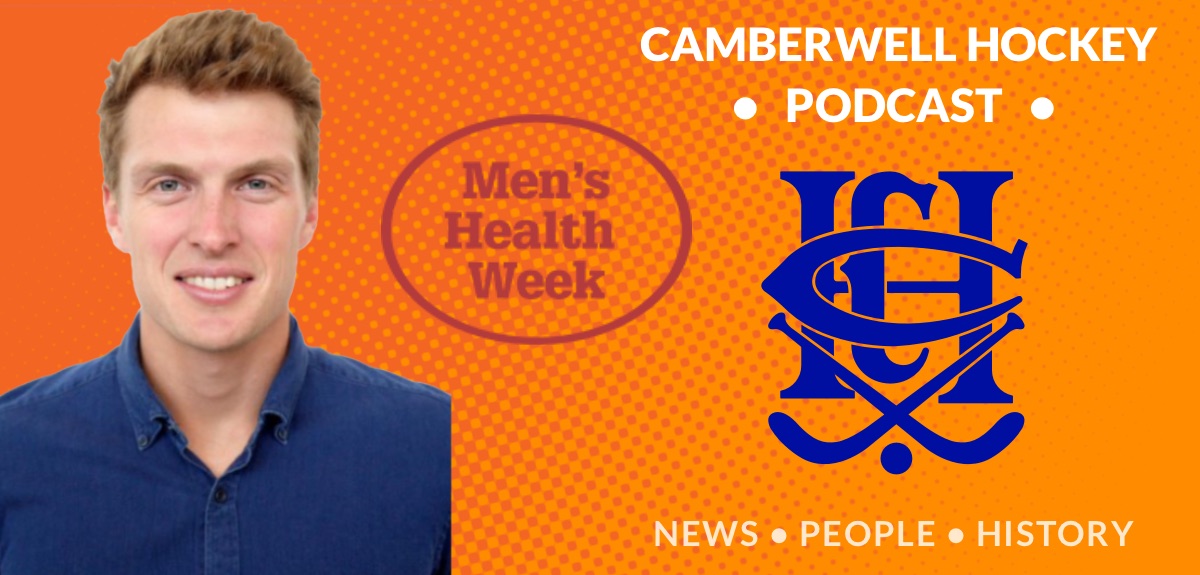
Sporting clubs around Australia have been wearing blue socks in support of Men’s Health Week; with special events to promote the health and wellbeing of men and boys. In this timely & pertinent first episode of season 2, Tim “Frosty” Everist joins the hosting crew to present Matt DeFina and Camberwell junior player Jack Brant.
Matt, aka Daffy, played junior and senior hockey at Camberwell as a goalkeeper and understudy of Lachie Dreher until he moved clubs to pursue Premier League and State hockey goals. He is currently the Premier League goalkeeper with Powerhouse St. Kilda hockey Club.
Professionally Matt is a registered psychologist working a Head of Programs at The Man Cave, which delivers programs empowering boys to become great men. You can contact Matt, and find out more about the Man Cave programs at themancave.life or on twitter @themancave_aus
Jack is an aspiring hockey and cricket player, who picked up hockey when he started at Camberwell Grammar two years ago after moving down from Queensland. Jack went through The Man Cave program late last year and now plays junior hockey at Camberwell.
If you or anyone you know needs help or someone to talk to, please reach out to any of the following services:
-
Lifeline on 13 11 14
-
Mens Line Australia 1300 78 99 78
-
Dads in Distress 1300 853 437
The hockey club also has a number of members accredited with the Mental Health First Aid Australia program. Check out camberwell.hockey/wellness for more information.
-
00:02:13: Men’s Health Round
-
00:03:33: Hockey Career
-
00:06:59: The Man Cave
-
00:11:17: Lockdown
-
00:14:37: Screen Time
-
00:16:48: Rites of Passage
-
00:22:20: Meaningful Conversations
-
00:30:34: Check-In
-
00:36:59: Jesse Foster Cup
Episode transcript
⚠️ Automated transcript
This transcript was generated automatically from the episode audio and lightly corrected. It may still contain transcription errors, and individual speakers are not labelled.
Sporting clubs around Australia have been wearing blue socks in support of Men’s Health Week, with special events to promote the health and well-being of men and boys. We’re back. Welcome to Season 2 of the Camberwell Hockey Club Podcast.
In this timely and pertinent first episode of Season 2, Tim ‘Frosty’ Everist joins the hosting crew to present Matt DeFina and Camberwell junior player Jack Brant. Matt is a former Camberwell player, a state representative, and current Premier League goalkeeper with Powerhouse St Kilda Hockey Club. Professionally, Matt is a registered psychologist, working as Head of Programs at the Man Cave, which delivers programs empowering boys to become great men. You can contact Matt and find out more about the Man Cave programs at themancave.life or on Twitter at themancave__oz. Please also visit menshealthweek.org.au for more information on Men’s Health Week.
This episode discusses issues relating to men’s mental health. If you or anyone you know needs help or someone to talk to, please reach out to any of the following services. Lifeline on 13 11 14. MensLine Australia on 1300 78 99 78. Or Dads in Distress on 1300 853 437. The club also has a number of members accredited with the Mental Health First Aid Australia program. Check out camberwell.hockey slash wellness for more information. Here’s Tim. Hi, it’s Tim Everist here, or as many of you know me around the club as Frosty. And thank you all for tuning in to this week’s episode of the Camberwell Hockey Club podcast.
Today, we are joined by former Powerhouse, Tim and Camberwell player, Victorian representative, and now psychologist, Matthew DeFina. Matt, firstly, thank you for joining us. Thanks, Frosty. Good to be here with you. For those who are unaware, this week is Men’s Health Week. So in today’s podcast, we’ll be talking through mental health, some of the fantastic work that Matt and the Man Cave have been doing. And we’ll also hear from Camberwell Grammar student and current junior Camberwell hockey player, Jack Brant, and his experience of the Man Cave programs. Jack, welcome and thank you for joining us. Thanks for having me, Tim.
So before we jump into all of that, Matt and Jack, do you want to talk us through a little bit about your hockey career and experience today? They’re probably a little bit different ends of the spectrum, but Jack, we might start with you. How did you stumble upon hockey? Well, I first started, I had to pick a sport and I didn’t really know what sport I wanted to pick, and I thought I’d just try something new, and I knew a few of my mates who played hockey. So I thought it would just be a good opportunity.
Is there anything that you enjoy the most about it? Is it the team aspect? I just love going out on Friday nights, playing a game with all my mates, and I just love the atmosphere. Yeah, I agree. Friday night under the lights is always good fun. And are you a defender or a forward? I like playing a bit of centre-half. Centre-half, oh, that’s a good one.
You get all the touches in there, don’t you?
And Matt, what about you? I know your career is a bit longer. Tell us a bit about that. Yeah, for sure. What I should say as well is it was really nice, first of all, to be asked by you, Frosty, to join you on this. And also really nice, Jack, for you to say yes to joining me. Jack went through the Man Cave program end of last year, and he’s also at Camberwell Grammar and also plays hockey at Camberwell Hockey Club.
So there’s just a whole lot of Camberwell going on in this conversation.
Yeah, it’s really good. So, yeah, I’m sure there will be some people listening that know who I am and there will be plenty that don’t as well. I grew up playing juniors at Camberwell. I started, Jack, kind of similar to you. Didn’t really want to play footy, soccer or any of the other sports. So I tried hockey, put on the goalie pads and never looked back. Yeah, played junior hockey with Frosty, who’s actually a few years younger than me. So we didn’t get to play at Camberwell hockey together. We played at school together.
Had Tony Thornton as my first coach. Grew up playing with Ed Unkles, Andy Philpott, Jimmy Webster, all those sorts of boys. And it was heaps of fun. Eventually, when I got to about 20, 21, I played Nationals for the Victorian under-21 team. There’s an old man called Lockie Dreher that was playing some very good hockey still. I don’t know how he was doing it. And yeah, I had an amazing mentoring relationship with him. And Rosie had been a big supporter of my development there. And there was an opportunity to play at Thames with a bunch of guys that I played state hockey with that I really connected with. So I decided to move there when I was 21, which was a really hard choice.
Then made Vikings that year in my first year and actually played for Northern Territory with you, Frosty, in National League later that year, yeah, in Melbourne, which was heaps of fun. And then, as many people would know, there was a bit of a political divide that happened at Thames, and I really had a choice to go back to Camberwell or to continue on with the boys I was there with. So I decided to go to Powerhouse, and it’s been an amazing, I think, seven or eight years at Powerhouse. We haven’t won a premiership, unfortunately. But since moving there, I continued to play a bit of Vikings and then eventually just continued to really enjoy playing Premier League. That’s sort of the brief background of my hockey as a goalkeeper. And any career highlights?
Well, you know what? I think one career highlight would have to be the only Premier League game I played at Matlock was when Lockie happened to get a yellow card and I was playing reserves afterwards, and Derek Van Den Driesen ran around the pitch to come find me. And I was already putting my gear on, and I ran out from the clubhouse side of Matlock so that I could go on to play after Ed and Steve Unkles defended these two short corners against Doncaster. And that was when Doncaster was a really good team back then. And yeah, and so I just ran onto the pitch and I’m like, oh my God, this is crazy.
Yeah, that was definitely a highlight, I think. I think I was filming that game. I remember, well, this is going to be interesting with Ed and Steve running out on the short corner. I think I made one save and I was happy, and that was my career of Premier League at Matlock. But, yeah, and I remember when we played for Northern Territory, I think I got one kick in that whole tournament. I played about seven minutes. I was playing behind Leon Haywood, who’s now the goalie for New Zealand.
And, yeah, that was a highlight for me. I’m like, great, 10 years of training to get one kick at National League. I’ll take it. So that was another highlight, I think. And Matt, now you’re a psychologist, trained psychologist, and have been working with the Man Cave. Can you tell us a bit about that and the issues and problems, I guess, you’re trying to address? So I trained as an organisational psychologist, which basically just means I’m trained in how do we create great places for people to live and to work and bring out the best in people.
And I love it because it’s strengths focused and it’s focused on creating great cultures and environments. I did some stints in corporate and eventually Man Cave’s work really pulled me out and I wanted to focus on that. And the Man Cave is all focused on how do we create the next generation of healthy young men. And that’s also why I wanted Jack to come on the podcast with us to talk about what his experience of the programs was like. And I guess the big thing for us is the statistics that we’re seeing around mental health, suicide and depression, even domestic violence as well and gender inequality; those are driven by something. And if we can catch it early enough, they’re preventable. And so when Man Cave started in 2014, it was looking at, well, what’s missing for young men and how do we prevent these statistics becoming a reality when they’re at their worst, around 16 years old for young men?
And what we came upon was, you know, basically the stereotype of what it means to be a man. And it was very rigid. We realised that if we could create a space where boys and men could fully be themselves and take off the mask that they wear every day and learn some skills for expression, their emotions, connecting with their mates in a different way, that we could potentially change the course of these boys’ lives. And the program was designed as a full day workshop that follows a rite of passage framework, which is an ancient framework used by Indigenous cultures around the world to transition their boys into healthy young men. We started delivering workshops in schools and boys loved it.
And today we’ve worked with over 20,000 men in Victoria and the approval rating is 95%, which I think is pretty amazing for a program that gets boys opening up and talking with each other. So that’s a bit about Man Cave and what we do. And I’m head of programs there and oversee all the workshops we run in schools and how we train our facilitators and also more broadly how Man Cave scales nationally and eventually internationally.
But, yeah, I’m happy to throw to Jack as well just to hear a few things from him about how he experienced the workshop. We started off, we were told that we were doing a Man Cave workshop and I was actually quite confused about what it was. I don’t know what I thought it was going to be, but I was definitely very pleasantly surprised when we did have it. I enjoyed how, like, the people teaching us had been, like, they made us feel very comfortable because they were, like, young men as well who had recently been through some bad mental health states, and they made us feel very comfortable with what we were doing and played lots of fun games with us to kind of get us confident before asking us a few questions.
And if you were trying to describe the day to someone that hadn’t been to it, how would you describe what happened in the workshop? Well, most of the day we were playing some, like, music guessing games and just games like that to make us comfortable, like I was saying before, but then we went on to, like, we were learning about men’s mental health and, like, the small amount of emotion that men are, like, supposed to show, and there’s all these, like, invisible rules that men are supposed to follow. You nailed that. That was so good. Thank you for sharing that. I mean, what did you and your mates get out of it? Has anything changed since? I probably learned the most about my peers, because a few of them I didn’t really know that well, but then I kind of learned a bit more about why they did what they did, because there were a few people who I thought were just mean, nasty people, but when they actually came out about, like, how they were feeling and their mental health state, it actually made me understand them a lot more. And do you think that’s reflected in the school brand now as well?
Yeah, definitely. I understand. I was going to ask as well, Jack, I don’t know how, how was COVID for you and working from home? And that, we can jump to you as well, how is it in terms of, from a Man Cave perspective, trying to do these programs? I’m not sure how that worked, but how did you find working from, or studying from home, Jack? It was definitely a very big challenge. I had a little, big hurdle I had to overcome, but probably for me the hardest part was I’m very bad at focusing and just getting the work done, and it was just very difficult for me, but online learning was something that was, yeah, just a big challenge. Yeah. And was that broached in the program as well, around, I guess, you’re isolated from your peers for a bit of time there? Was that something that was broached and brought up in the workshop? Yeah, a lot of people came out about how they were finding it very difficult to actually, like, make friends, and, like, they didn’t really have many friends, like, due to COVID. Yeah, thanks, Jack. First I just want to say you speak really well and you articulate yourself really well, and I love how you just slow down before you answer a question and think about it, because then when you do speak I know that you really mean what you say.
So thank you. I think, like, Frosty, like, for you and I, having obviously gone to Camberwell and been in Jack’s shoes, one of the reflections I’ve had, and, like, I think what’s relevant for this discussion as well, is I had a really good experience at Camberwell, Camberwell Grammar that is, and Camberwell Hockey Club. But I think on reflection realised that there was a mask and armour that I put on when I went to school, and, like, I actually had a fair bit going on at home myself. My parents were split since I was one year old and I was going between houses every week. There was some challenging family situations happening.
I was playing a lot of sport and was pretty exhausted and felt a lot of pressure to be good at sport and to be good at things, and struggled to connect with some of my mates, but there was nothing really there to help. And so we just kind of continued on. And I turned 30 yesterday and had dinner with all my schoolmates that I’ve been friends with from Camberwell since I was 14. And, like, now we’re trying to start to handle marriages and relationship breakups and kids and financial situations and challenges with our own parents who are going through their things and we’re trying to support them.
And it’s interesting now, like, we’re only just starting to move into being able to have those conversations to fully support each other as mates in our 30s. What could it have looked like if we had something like Man Cave when we were back at school?
And also, like, you know, what can we do not just for young men like Jack, but adults like you and I that are starting to work through some of those challenges ourselves as well. Yeah, definitely. I was thinking along similar lines as well, how beneficial that program would have been had we been 15 and it had been at Camberwell Grammar. Again, probably understand more outside of what other people have going on in their lives, and I think that’s really helpful.
I just wanted to pick up on one other point before we moved on.
Lockdowns last year, we usually run our face-to-face workshops with boys and we couldn’t. And so we actually, we ran about 1,200 boys through an online Zoom program and we asked them, we asked them a number of questions around what their experience of lockdowns was like. And we ended up with 500 boys telling us effectively that they really struggled with their parents, and their parents not liking them being on their phones heaps and also not liking them gaming a lot. And what the boys were trying to tell us was that’s actually how they were connecting with their friends because obviously they couldn’t see them.
And actually the boys just wanted to be out playing sport and connecting with each other in the usual way they do. And there was just misunderstanding in the family, and boys also felt a lot of pressure from their parents to be studying really hard and to be performing at school even though they were obviously trying to deal with lockdowns at the same time. So I don’t know if that lines up with your experience, Jack, but that was what 500 boys shared with us last year as well. Yeah, it was definitely, there were quite a few boys that did talk about how sometimes their parents would be, like, arguing or something and then their parents’ excuse would be that it was because of them, and, like, because they were always on their screens and never helping, but sometimes they felt that they had to escape and get away from their parents by going on their screens.
Yeah, it’s a really interesting and tough dynamic, I guess. Yeah, and, like, Jack, for you, how did you manage it when you were there last year and what’s it been like connecting back with your classmates since coming back? I feel like I was very kind of just centred around my form class, my mates, because they were the only people I saw, like the people I was having online classes with. I didn’t really see, like, anyone else who I’d, like, talk to and was mates with. I didn’t really see them as much. Yeah, because I guess the form classes, it’s been a while since year eight for me, but the form classes at year eight, you go through the maths together, the science together. So you do all of that together, don’t you?
Yeah. I guess one thing I can speak to briefly is this idea that we don’t really have a formal rite of passage for young men from boys into manhood. And so what happens instead is boys will often create it for themselves, or there will be older boys that aren’t, you know, really in a position to be doing it who might do it. So you’re 11 or 12, say, in a school setting. And what Man Cave is trying to do and what we think just needs to exist more broadly is how do we create a rite of passage where there’s a clear line in the sand for a boy stepping into his adult self, and all we’re talking about really is a shift in psychological, emotional and social perspectives and views, and things like, rather than thinking like I’m the centre of the universe, they’re going, I’m a part of the universe, I’m a part of a community, how can I contribute?
And because that’s not facilitated, then we can end up with men that feel lost with maybe a loss of sense of identity or purpose,
which can lead to some of those mental health outcomes.
And we can also end up with, I guess it becomes confusing as to what it means to be a man. And there are some mixed messages out there right now as well. We’re being told to show no emotion. So the stereotype is around showing no emotion, but now we’re being asked to show emotion, be vulnerable, open up and talk, which is really important. And at the same time, we also need to be strong and show leadership and make decisions. And it’s a confusing time to be a man in that space as well.
So Matt, what do you think we’re missing in terms of a broader picture for young men and men alike? I think a lot of it comes back to this idea that there’s not really a clear rite of passage into manhood for young men. And so, like, when I was at school, it was who was the best at sport, who could get with the most girls on a weekend, who grew facial hair first, who could drink the most beers, who even lost their virginity first. And that was the definition of becoming a man. While those things can be really positive in someone’s life, they can also be pretty damaging to a social group.
And so what we really think is missing is that clear rite of passage where there’s a moment where a boy understands his place in the world and then understands the shift that he needs to make psychologically, emotionally and socially, from what we call boy psychology into man psychology. And all that is, is shifting from, I think, a thought process like I’m the, I’m at the centre of the universe as a boy, and then as a man I’m a part of the universe; or I create safety for myself versus I create safety for the community and for others; and other males are competition versus other males there to have a relationship with and build friendships with. And these are just really basic things, but what we try to do and what we think needs to happen more is that shift, that clear shift and a clear moment in time, and ideally before they’re 16.
There’s some great work by Arne Rubinstein, who’s a doctor based in Byron Bay, who runs the Rite of Passage Institute. And if anyone’s interested, his book’s really worth looking at. It goes into more detail about what’s missing. But, yeah, I think that’s more so what’s missing. Like, Frosty, forgive me if I’m wrong, but, like, I think back to us as teenagers,
my rite of passage was going on a gap year. I actually did a gap year with Ed Unkles over in England. And for him and I, that was our rite of passage for us because we were free, we could explore, we could venture, and we came back and we changed because we had to be self-sufficient and independent and rely on ourselves.
And we kind of created that for ourselves, but I came back and there were a bunch of my mates that had just gone straight to uni and maybe they missed out on that. Yeah, that was certainly my case. I went straight to uni and jumped into more hockey than I was doing at school. So it’s interesting that you bring up that gap year as a transition for you to help you find yourself a little bit, I guess, is what you’re saying as well. Yeah, exactly, exactly.
And so coming back to, I guess, the role of adults, and we call them elders as well, is like how can parents that are listening create some of these moments for their young people in their lives, not just parents but aunties, uncles, whoever it is. My little sister, she’s coming back from Marshmead today and she’s been away for eight weeks being self-sufficient out on a campsite with her school friends. And I’ve had a chat with my family and said we need to understand that she’s probably gone through some shifts and changes, and we need to create space for her to have grown and expanded and have new and different perspectives and want to shift into a new identity, which has evolved.
And that obviously involves my mum, my stepdad and me, relating to her differently. And that’s also part of the growth here. It’s like, as young people want to grow up, the adults around them also need to support that. Yeah. I’d be interested to know as well, Jack, then, did you have a conversation with your parents after the workshop that Man Cave ran around some of these topics that Matt just mentioned?
Yeah, I definitely did, probably mostly with my dad. I just talked about, I was probably just honestly quite shocked at, we wrote them all down on a board and I was just quite blown away at how, like, how little emotion that we’re, like, supposed to show. So I definitely did talk to my dad a lot about what we did and asked him about a few things. Yeah, great. If you’re happy to, Jack, what were some of the things you guys talked about? I mostly just talked about, like, what we did, but I also kind of asked him a little bit about, like, a little bit about, like, the mental health and, like, kind of his experience. And what was it like hearing your dad speak to you like that? It was really good hearing, like, from, like, someone that I knew and trusted a lot, like my dad, hearing it from him. And do you know much about your dad’s, or your parents’, what they were like when they were your age?
Yeah, I know that they both grew up on farms actually, and my dad had a little bit of a rough upbringing on his farm with his parents. Yeah. That’s awesome you’ve had those conversations with him after the program. I think, like, Frosty, conversations like that are so important. Yeah. And often, like, I’m thinking again just about people that are our age but also people that are parents and even grandparents, like how to connect with young men, and what our facilitators do in the workshop that we think works really well, and that I encourage anyone listening that wants to have an impact on young men in their life to do, is to share stories from when they were the same age as the young person they’re connecting with, and not to use those to give advice but to just share a story, so that they can, because young people just forget that people older than them were actually also a teenager and also a child, and so just telling stories is a great way of obviously building relationship but also, yeah, connecting with young men in a way that then enables them to take their own lessons from those stories. And if there was, like, one thing, there’s a couple of things probably, but if there was one thing that I’d offer to anyone listening, it’d certainly be to share more stories about what you were like when you were the same age as the people you’re speaking with, the young people in your life.
And I guess that kind of flows on well too. Do you give in these programs young men, what tools and tips, I guess, outside of those discussions that they can have with their parents? What are the things that you’re trying to get them to do or things that they can take away and implement in their own lives? Jack, for you, what are some of the things that you remember from the day in terms of tools or ideas that you’ve taken from the program? I remember the most about, well, just like remembering, like if I think something about a certain person, I kind of just remember that, like, what we talked about, like they could be going through something, like, really bad, and just doing a small kind act can be really, like, just nice to them and they’d really appreciate it.
Yeah, nice. And do you remember any of the particular activities you did, and have you used them since? We did, we mostly just talked about each other’s, and we heard from Troy, Andy and Reece who are my teachers for that. They talked about, like, their experience and how they’d been feeling, and then we mostly just played a few games after that. Yeah, nice. Lots of games.
Some of the tools. So the first one is just what Jack actually spoke about earlier in the podcast, which is building awareness of the rules of masculinity, which a lot of us aren’t initially aware of, and especially when we’re in a room with boys it’s kind of mind-blowing to them that these even exist, and then they start to realise that that’s what’s happening in their group. And so building awareness of that, and then giving them the choice to be different, to start connecting in a different way, that’s, I would say, one of the first pieces, is giving them awareness of the differences between what it means to be a good man, which is, you know, leading by our values and connecting in that way, versus what it means to be a real man, which is kind of what the stereotype tells us we should be, and the media. Another thing we do, which I think is really one of our key tools, is called a check-in, and all this involves is giving someone a couple of minutes of uninterrupted time to talk about how they’re feeling. And all you say at the start is, Matt, checking in, talk about how I’m feeling, try not to talk about what I’ve been doing but actually how I’m feeling, which usually involves needing to slow down and feel what’s going on in your body and talking from there.
And then finishing with, checked in. And no one’s allowed to interrupt you during that time. And also afterwards, no one’s allowed to give you advice. And what we see with the boys is they learn things about each other that they didn’t even know were there, for boys that have known each other for years. And that’s actually one of the powerful things, is realising they’re not alone in the struggles they’re going through.
One or two of the other things which I’ll mention is we also ask the boys to draw up a vision for their future and what kind of man they want to become and what are the values they want to live by. And this starts to ingrain some ideas around, I guess, who they are, what their identity is and what kind of man they want to become, which starts to give them an idea about that transition we talked about and how do they want to step into their manhood. And the last one, which I think is one of the most powerful and is particularly difficult in Australian culture, is an honouring, honouring the unique spirit and the unique strengths that you see in the other person.
And all that involves for the boys is stepping in and just saying, hey, like, if I was going to say it to you, Jack, I’d say, hey, Jack, I want to honour you for being really kind and thoughtful and also thinking really carefully about your words before you use them. And I can see how much you care about your friends as well. And I mean all the things I just said to you.
So thanks. Thanks for being here as well and for choosing to step into this opportunity.
And I don’t know what it is, but just in Australia, we’re really good at cutting each other down and not getting around each other and celebrating each other’s strengths and saying that sort of stuff to our friends. So that would be another tool that I’d say we give the boys. But if there’s, again, any person there that’s listening that has a young man in their life, it takes a bit of courage. It actually takes courage for me to step forward and say that sort of thing to my sister, takes courage for me as well. But it makes such a big difference, because what’s missing as well is young men understanding from the adults around them what it is that’s special about them, what’s unique, what are the gifts they have to actually give to the world.
And that would be another tool that I think is really valuable. And there’s also a lot of these tools that are accessible on our social media platforms. So TikTok, Instagram, YouTube and also our website. If anyone wants to, like, go see more things, there’s plenty on there as well. Yeah, great. I was going to ask you about that. How do people access these if they’re not in the programs, because it sounds like there’s some great resources out there that you’re putting out there as part of the team.
So that would be good. I guess I was thinking as well, what do you think a hockey club can be doing as well in this space? I think it’s probably a lot of those things you’ve already covered, but I’m thinking back to Camberwell Hockey Club as an example. What is a club’s role in all of these things as well? Because we’ve got juniors, both male and female. And I know we’ve been talking a lot about men, but it also, there’s the aspect of female mental health as well. What do you think the club’s role in helping all of these things is?
I mean, knowing Camberwell, I’m sure you’re already doing lots of amazing things.
I think I just want to pick up on one point you just mentioned there, which is the way that men connect with and relate to women around the club. And I think that’s a really important starting point, because the way that we communicate with each other as mates, in the men’s section, and the way that then we speak to and relate to women in the club, it gets seen by young people. They see what goes on. And so for anyone that’s at the club that’s older, that’s not in juniors anymore and is thinking that they don’t have a responsibility for it, then they’re probably kind of missing the point, which is that young people are always watching and always taking note of what’s going on and what’s acceptable.
And, you know, having been at Camberwell for many, many years, I know what a beautiful club it is. And I guess the first thing I’d say is, from a man’s perspective, they can take responsibility for how they treat their friends and also then how they connect with the women. And what that means is just basic respect, you know, saying hello, asking how they are, and then actually, you know, finding ways to connect in a healthy way. There’s definitely a role for juniors and seniors to play. And I think, when, I know I’m sure the senior players are probably still coaching the juniors there.
That’s just from the perspective of having role models that are healthy in their lives; that makes a massive difference. And, you know, what would it look like to have coaches coaching across genders? What would it look like if a Premier League man actually said, hey, you know what, I actually want to coach the girls team? And what would it look like if you had a female player that’s one of the best players in Premier League, or even just one of the best coaches, or even just a great leader, saying, hey, I want to coach the men’s team, I want to coach the under-14 boys team? And if that’s not already happening, why aren’t we enabling it? Because if we’re not enabling that, then we are continuing to run down the same lines of, you know, traditionally speaking, if I can be honest about it. KA is an amazing example of a female coach that stepped in at Camberwell and did a great job there and has gone on to bigger and better things in hockey as well.
But overall, most of the coaches in men’s Premier League are men. And we had Marcia Godere, I’ve definitely said her name wrong, by the way, because she’s Dutch, so I’m sorry. She coached us at Powerhouse for a few years and she was amazing. She was the Dutch captain of one of the world’s best women’s hockey teams, and to be coached by her was incredible. So how do we find more opportunities also to connect the club across sections and also across age groups? I think that’s one of the best things that could be done as a starting point.
And I’m sure there’s many other things that are already happening there as well. One other thing I would say is, yeah, just at a team level and a club level, it was pretty obvious, I think, during lockdowns last year, how much we all missed community sport and how much we all missed connecting. And it’s just a place where we all gather and it gives us meaning and identity and it gives us community. What are the ways in which, that within the clubs and the teams, I mean, that the players can be connecting in a new way? And so what does it look like on the way to a game to do a check-in?
We used to do check-ins on the way to Powerhouse Premier League games. And the whole purpose of that, and we’ve looked at this from a high-performance perspective and talked to a few AFL clubs about what this looks like as well, the whole process for that is, let’s say you and I drive into a game, and we used to drive to training and games together. Yeah, we used to a lot. Yeah. And we’ve had a crap day at work or we had an argument with someone before the game.
If you just gave me three or four minutes to do a check-in where I can talk without any interruption, and I know that you’re not going to give me advice at the end or rescue me. And then I get to the ground and I go, great, I don’t have to carry that baggage around with me anymore. Now I can go play. And that’s actually going to improve performance. So what would it look like if players in their cars on the way to games, or even parents on the way to a game with their, you know, it doesn’t have to just be their boys, with their young kids, let them do a check-in?
And then go great and then turn the focus to great and now what do you want to get out of the game tonight? What do you want to focus on for the game? That is then starting to build in some of these tools to just life, which is not just improving mental health but also improving performance on the pitch. Yeah, that’s a really cool aspect. Probably hadn’t thought of that before.
Given how much we used to drive into hockey together as well. Yeah, and, like, it’s kind of awkward, right? Like when someone says, hey, let’s do a check-in, and you’re like, oh, do we have to? But always afterwards it feels better, because as Jack said, I think you said it really well at the start, mate. Actually, you said it to me on the phone yesterday, and it’s not personal, so do you mind if I share it? No, not at all. Okay.
Jack just said to me, you know, one of the things he got out of the program was that he got to talk openly about some of the things that were on his mind and he got to then acknowledge them and his friends got to hear them, and that took a weight off his shoulders because then it was out there and he didn’t have to carry it around with him anymore. And that’s all the check-in does as a really basic tool. So, yeah, there’s guides on our website as well for how to hold it, and there’s guides on our YouTube for how to hold them with young people also.
But I think you’ve already got the script. Actually, the hardest part is just doing it.
Yeah, exactly right. And I guess there’s no time better than in the moment as well. You can start with, I guess, imagine, how are you going type thing, and that can automatically lead to a check-in. Yeah, exactly. And there is power in, like, the checking in, checked in, because between those two phrases, there’s an understanding between the two people doing it, or there could be a group of people doing it, that they won’t be interrupted. And so it means that they can go slow and they can actually think through where they’re at.
Something that comes to mind, and I guess thinking about some of the initiatives that Camberwell have coming up as well, we have the Jesse Foster Cup, which is the match that Camberwell played against Tim in honour of Jesse Foster. And it is a really important occasion to raise awareness around mental health. Jesse was a very talented hockey player by all accounts who played for Camberwell and played and coached at Tim. He suffered from mental illness and tragically took his own life at 32 years of age. And as a group, we talk about the importance of passing on while we’re playing for the Jesse Foster Cup. It is something that, when I first joined the group, Hamish Ridland passed on, and in short everyone understood the meaning and the occasion. And it is now something that we’re also trying to pass on to the younger members of the group who are coming through now.
It’s something that definitely springs to mind off the back of Men’s Health Week this week. I was also around when the Jesse Foster Cup, I think, came in, and remember how powerful Hamish was and how much he cared about it.
And I’m just interested to know why it’s so important to you personally, but also why it’s so important to the current playing group to continue the legacy of Jesse and playing for the Cup, but more importantly, having some of those conversations at a team level. I think back as well to our pre-season camp a few, I guess, at the start of 2020 now.
And our new coach, we had a session where we talked about, or talked through, our heroes and hardships, and I think that was a really powerful conversation, as a lot of us really opened up. And you’re spending a lot of time with people, you know, three sessions a week, two games, two matches, sorry, one game, two matches.
Sorry, two trainings and one match.
And you’re spending a lot of time with people, but you still sometimes don’t necessarily know what’s going on outside of their everyday lives. You can be spending time with people and not necessarily know. So I guess the importance of games like these is you are making sure that you are checking in and actually are asking how other people are going. And I think that’s something, when we opened up and we’re trying to be vulnerable in front of the group, especially when we had this session at the start of pre-season, it is really powerful.
And I think people understand the significance of these games, both Tim and Camberwell, in the context of asking people how you’re going and checking in, are you okay? Because, as you said, I know you call them check-in sessions, but that can lead to something as well greater.
And I guess it’s also important we have a conversation in our group, particularly around passing on that message to younger people in the group. Obviously, I guess the older generation who I played with had played with Jesse. I hadn’t played with Jesse myself, but it’s important to continue the messaging throughout each level of the group, each age level, as it is something that it’s important to continue having these conversations. I think that’s something that really comes to mind for me, is just we are making sure that everyone in our team is okay, and it’s okay to be vulnerable. It’s okay to, you know, cry.
We all face different things in our lives that are challenging and we all deal with them in different ways. But at least, you know, you’ve got people around you who are going to be there to support you in your time of need. And that’s something I find really powerful about being in, particularly in the Camberwell men’s hockey league. And it’s not just a Premier League team, it’s the reserve teams as well, that we’re all there for each other. And I think I’d hope everyone thinks that if they do face anything that is a struggle or they do have issues, that there is a larger group of people who are there and I’m sure would be ready to drop anything to help them.
Can I ask you another question? Yeah. We don’t need to go into the details, and I’m happy to, but I know you’ve had some pretty challenging couple of years, and I have no doubt the guys at the club and the club itself has been a massive support for you. What’s it been like being supported by the group and the club the last few years as you’ve navigated some of those challenges? Yeah, definitely. I mean, I think I’ve always found hockey a bit of an escape,
and it’s something I enjoy going down to, especially, and it was tough last year as well. So, Jack, my dad, he was diagnosed with leukaemia in October 2019 for the second time. And the first time he was diagnosed when I was 15. And that was really quite challenging. I probably at 15 didn’t know quite how to deal with it. I was upset. I tried to throw myself into reading everything I could about it as a way of dealing with it. And sometimes I think I probably didn’t speak enough about it at the time. And it was probably those things, I think, if I had a check-in session when I was 15, it would have been really beneficial for me.
And last year it was challenging seeing dad in hospital and he was going back a lot and I couldn’t go into hospital. So I was trying to give him a call on video every night to see how he was going. And I couldn’t see mum either. So there was a limit of two people in the hospital. And at the time, my sister was living with mum. So I wasn’t allowed to go into the hospital. So I’d always give mum and dad a ring when she was in there. And I guess just being a part of a group who knows what’s happening, there were people always checking in and seeing how I was going, especially with, I wasn’t seeing them as much at the time without training and stuff.
But it is powerful knowing that there’s people checking in. And one thing as well that was really fantastic was people started, there’s a good conversation around blood donation and donating as a club,
because I’ve seen dad, and it’s not just my dad, there’s a lot of people in the world who need lots of blood, but it’s something that’s so small. Donating blood can impact a lot, many lives as well. So knowing those things and having those discussions with people about those types of things as well, it feels you, it’s hard at the time, but it also fills you with a bit of joy that there’s those things happening. I know you’re talking about it a lot, man, but thanks for just sharing it. And also just, it’s so good that Jack can hear this as well.
Yeah.
Yeah, I think I struggle at times to put it into words that I’d like to, because I do get emotional when I speak about it and the impact it’s had on my family. But I know Dad, he couldn’t wait for, as soon as he was out of hospital, he couldn’t wait to get down to Matlock on a Saturday afternoon and talk a bit of rubbish to everyone who’s up in the gallery and catch up with all the players. And he really took a lot of comfort out of knowing that there were Camberwell players as well, older and younger, who were checking in on him, and the Masters as well.
So that was something he, I know, took a lot of solace out of and took a lot of comfort out of, that there were people who were there helping him out, and knew that there would be people helping out mum when she was at home with my sister as well. Yeah. And like you, like, Frosty, you asked me before, like, what role does a hockey club play in this? I think your story and, like, the role they’ve played for you in this is just such a beautiful example of what it can look like and how important it is.
Yeah, I think one thing I just wanted to mention before we moved to wherever we go next is just, you know, often the question is raised, you know, around things like Jesse Foster Cup and different things.
How do I help someone? And I think the first thing is just to make sure that your house is in order before you go and help anyone else’s. And one of the hardest parts, when we see this from Movember research that comes out, is that people are more willing to listen than they are willing to talk. So two-thirds of men are willing to listen but only a third of men are willing to actually talk about how they are. And the courageous thing to do is not necessarily to be the one listening, which obviously is necessary, but to actually be the one that, you know, goes and asks and reaches out and says, I actually need some help.
And the important thing, and the role that club members can play and friends can play, is recognising when someone’s behaviour has changed is one of the first signs that someone’s mental health is struggling. Have they stopped coming to training? Have they lost or put on a lot of weight? Do they seem just to be a little bit different in the way that their demeanour is? And it’s totally okay, with their permission, just to say, hey, I’ve just noticed these few things have changed, how are you?
What’s going on at the moment? And I think, unfortunately, in many ways in our society, which is pretty civilised, some raw emotions and some real challenges aren’t always, there’s not always space for them to come to the surface. And that’s why some of us can keep more quiet. And just noticing and just mentioning it and just saying, I’ve noticed that you’ve changed a little bit, how are you going?
And then creating the space for that person to talk can be really powerful.
And I think just in relation to the Jesse Foster Cup, I think my encouragement just to everyone that’s involved as well is, before you go and offer your support to others, slow down and actually ask yourself how you’re going
and start from that place, because that’s going to be the thing that obviously enables you to look after yourself but also start to talk about it if you do need help. And it’s not even about help. It’s actually just about, you know, whatever you’re experiencing. But also it’s going to put you in a better position to support others if that’s what you eventually need to do. It’s been a great conversation. I really enjoyed hearing your perspective of it. And Matt, obviously, hearing you talk through all these things has been fantastic, and I’m sure all of the listeners will really enjoy this as well.
And Jack, as well, for you to open up on this podcast and talk through your experiences and even opening up about the conversations you’ve had with your dad, it is challenging and I really do thank you for that as well. I think that one thing was definitely that, because I know you were talking about your dad before, but, like, my grandma got diagnosed with cancer as well, and that was actually mostly what I was talking about. That’s, like, why I opened up at Man Cave, because I had someone to ask me, like, if I’d like to check in.
So I did check in just about how I was feeling about that. Yeah, nice.
Yeah, thanks. Thanks, Frosty and Jack. It’s been awesome. I hope it’s really valuable to people who are listening. And, like, honestly, if anyone wants to reach out to me personally, I’m happy to share my details and continue the conversation and be involved in whatever way. And I think it’s just also just so good that you’re even creating a podcast and having a conversation about this. And, you know, this is something that can spread really easily within the community beyond just Camberwell, I’m sure, that then leads to more and more conversations.
And so even just this conversation hopefully will have an impact on people’s lives.
So, yeah, thank you. Thanks, Tim, for inviting me and Jack on and creating the space for us to talk about it. And, yeah, Jack, thanks again just for taking the opportunity and showing your leadership and being open. Yeah, thank you for asking me. All right. Well, thank you both. It’s been great to chat to you both.
You’ve been listening to the Camberwell Hockey Podcast. We’d like to send a big thank you to our hosting team, our guests, and you, the listener, for your support. If you enjoy the show, please give us a review on iTunes or wherever you get your podcasts. This show is recorded and produced by Camberwell Hockey Club in Melbourne, Australia. If you have any feedback, comments or questions, please find us on Twitter at camberwell underscore HC or see more information on our website camberwell.hockey. See you next week.