Season 2 Episode 02 - Pride Cup Round
20 July 2021 · Steve Prior
Listen to this episode ·
Subscribe in Apple Podcasts
At our club or workplace, we all want everyone to feel welcome. To feel included, valued, respected and safe. Unfortunately, this is not always a given. In this episode you’ll meet members of our Pride Committee and hear about what they’re doing with the club and wider associations to raise awareness & education to make it so.
Tom Winter returns to host Pride Committee chair Stacy Clarke and members Julie Patterson & Sam Daily. You can reach the Pride committee on email pride@camberwellhockeyclub.com.au
-
00:00:43: Introductions
-
00:05:31: Inclusion
-
00:11:42: Committee Goals
-
00:16:00: Pride Cup
-
00:21:10: Education
-
00:25:59: Pronouns
Episode transcript
⚠️ Automated transcript
This transcript was generated automatically from the episode audio and lightly corrected. It may still contain transcription errors, and individual speakers are not labelled.
At our club or workplace, we all want everyone to feel welcome — to feel included, valued, respected and safe. Unfortunately, this is not always a given. In this episode, you’ll meet members of our Pride Committee and hear about what they’re doing with the club and wider associations to raise awareness and education to make it so. Welcome to the Camberwell Hockey Podcast. Tom Winter returns to host committee chair Stacy Clarke and members Julia Patterson and Sam Daly.
You can reach the Pride Committee on email: pride@camberwellhockeyclub.com.au. Here’s Tom.
Welcome back to the CHC podcast, everybody, back for another season in 2021. Tonight we welcome back two podcast veterans in Samantha Daly and Julia Patterson, and we also welcome a first-gamer to the CHC podcast in Stacy Clarke. Now, Stacy, you’re the chairperson of the CHC Pride Committee. Can you give us a quick background on your hockey life, and then also just give us a really brief rundown on what exactly the CHC Pride Committee is?
Certainly. Hi, Tom. Look, I guess for myself, from hockey — I grew up in a hockey family in Tassie. All three of us kids went through hockey. My sister plays here at Camberwell as well, and was the reason I moved across to Camberwell when I relocated to Melbourne. So from a young age, hockey’s just been in my blood. I’d get distracted by other sports, but always seem to come back to it.
Sadly, lately, due to too many concussion injuries as a goalie, I’ve had to retire from playing. But I’ve still been involved, and from my own background as a transgender athlete, it was a natural progression into helping continue the amazing work the club’s been doing around pride over the years. It was great to be starting to help get the committee together and build on the amazing work the club’s been doing.
Awesome. Thanks. Well, great to have you on the first podcast, Stacy. Next, we’ll go across to Julia Patterson. Now, Julia, for those avid listeners of the CHC podcast, they’re going to recognise you from the mental health committee that we recorded last year.
But just to refresh us all, can you give us a quick rundown on your involvement on and off the field, because I know that you do a host of work off the field at Camberwell? Yeah, hi, I’m Julia. I use she/her pronouns. On the field, I’m currently the reserve scully, and I also work in the canteen. So you’ll often see me running around getting more cases of beer on Premier League weekends.
And I’m on the Pride and Mental Health Committees. Huge. Thanks, Julia — just critical to the running of the Camberwell Hockey Club, on and off the field. Now, our last guest with us tonight, we have Dr. Sam Daly. Now, people will recognise you, Sam, from years and years and years of Premier League hockey at Camberwell, Victorian representation, Australia, and then also on the medical — the COVID episode of the Camberwell Hockey Podcast.
But for those who have somehow missed you through the years, do you want to give us a quick rundown on who you are and your involvement with the club? Sure. Thanks, Tom. So I think I joined Camberwell Hockey in under-nines and I’ve played right through, including State League One. I took a bit of a break when I moved up to Albury-Wodonga after finishing medical school, and I’ve just come back to the club last year to have a crack at trying to play Premier League again. It’s been a lot of fun. I’m commuting from Gippsland, but it’s totally worth it and I’m really enjoying it. Last year, when I came back to the club, the opportunity came to join the Pride Committee, and I thought it was a really good chance to, again, give back to the club.
There are multiple reasons why I wanted to join, all about inclusion. Particularly, I work as a rural GP, so I see how important inclusion can be for my patients. And I also introduced my fiancée to the club this year, Jess, and she’s been welcomed with caring, loving arms to the Camberwell family. So I guess I wanted to give back to the club for that as well. Awesome. Thanks, Sam. So we’ve got three huge contributors here, which is unreal — to have you three on the podcast and be able to talk about some of the work that’s been going on in the inclusion space.
So inclusion is obviously such a big space, just generally and societally at the moment. We’re now focusing in and narrowing our view to the Camberwell Hockey Club in the first instance, and then hopefully we can broaden it out after that. Julia, just as far as inclusion goes — I know that you’re studying and you work and you play hockey and stuff — do you have much experience with inclusion outside of the hockey club? Yeah. Because I’m doing a psych degree, I’m currently doing my honours project on ADHD and autism, which I think is a really misunderstood area in general. And outside of hockey, I’m part of my uni’s Disabilities and Carers Committee.
So I’m mostly involved in inclusion work in the disability sector — researching it and trying to make the uni more accessible and inclusive. So that’s kind of my main gig, but I thought the Camberwell Pride Committee was a really good, nice opportunity to put my passions in this sector into use. Amazing. And it’s certainly unreal work you’re doing — both at the university to help inclusion in that disability space, and now working in the Pride Committee. So, Stacy, obviously you are the boss of the committee, you are our chairperson. I know that we’ve all been involved in inclusion a bit, but is there anything outside of the hockey club or within the hockey club that sort of drew you to be part of, and chair in fact, the Pride Committee when it opened up last year?
A few different things. First of all, relocating from Rizzi to Melbourne back in 2014, I was playing as a goalie still then. My sister said, come along, you don’t have a choice — we’re a family of hockey players, you’re playing at Camberwell.
And from there, I started to join. I’d been, I guess, living as my true authentic female self for about six years at that stage. But it’s still daunting, the sporting field, especially as a female player. But I sort of found that it was never a question. It was always just, Stacy is our goalie. I ended up playing at the Premier League reserve level.
And that just made a huge difference to me. But I could also see how much difference what the club’s doing makes as well. I think at that time, Ed and Sophie and others were heavily involved in doing a lot around pride. Back then, Camberwell was involved in the state government’s Fair Go Sport promotions and networks and things, and I could just see that it wasn’t a token, “hey, we support pride.” It really was hands-on awareness at all different levels. You could see it on the pitch and around people: people turn up with the partners that they love, and it doesn’t really matter who it is — you’re all welcome, and you’re welcome on the pitch. We all know how much sport helps our mental health, and how much we sometimes get grumpy if we can’t play — especially with the whole season last year cancelled. It’s documented that sport is a huge mental health benefit. And for those in the LGBTIQA+ community, a lot of things in life — they may lose family, they may lose partners, they may lose access to kids, they may lose work as well, just by trying to live as their true authentic self with the true partner that they feel connected with.
And if they just have that one space in sport where they know they can come along and be part of the same team, just as anyone else, that really makes a big difference for themselves, on and off the pitch. I know for myself, a couple of years ago when I was struggling with my own mental health, the club was really supportive and allowed me time off, and then slowly back in. That sort of made a big difference.
And then, after the years of the amazing work Ed and Sophie were doing, and others, they wanted to try and step down. The initiative was taken at the top level — our president, Simon, reached out and said, “Hey, Stacy, do you want to try and help put a Pride Committee together, or a Diversity Committee?” We’re still trying to figure out what that was, so we can build upon the amazing work that Camberwell had been doing.
Yeah, there’s a lot to that answer, but I think the key there, Stacy, is it shows that the Pride Committee at Camberwell is not just a name for a group of us who catch up occasionally. You’ve mentioned there that you were accepted as a player and on committees, and just coming down to watch the club, and all the way through to the board of the club being so supportive of the Pride Committee and inclusion more generally.
And I think that, as a club, we’re really leading the way. I know that a lot of other clubs in Victoria do a great job in this space too, but leading the way just to show that, well, if you want to be part of our club — whether you want to play hockey or not — then come one, come all, and we’ll open our arms to everyone no matter who they are, and welcome them exactly as they are. So I think you also touched there briefly on the work that Ed Unkles and Sophie Sheen have done, sort of pioneering the Fair Go Sport round, I don’t know, probably five or six years ago now.
It’s now moved into the Pride Cup round, which is obviously really exciting. With the committee — so, obviously, the CHC Pride Committee — Sam, do we have any goals as a committee that you’d be prepared to go on the record as saying? Or are we here really just to kind of get the ball rolling a little bit more into the pride space? I think we probably did write down some formal goals when we created our committee, but I probably can’t give you them off the top of my head. But I’d say that, from my understanding of what we’re aiming to do, it’s probably a few things.
So one is to create a safe space for everyone at the club. And yes, our committee is kind of more focused on gender and sexual diversity and inclusion in that regard, but I think all four of us are also keen to make an inclusive space for everyone. And that goes across different cultures, ages, everything. So creating a safe space would probably be our number one. And we’ve talked about — that involves a few things. One is awareness and education of our club members. That’s been one thing that we’ve really tried to take on board over the last 18 months or so, getting education out as much as we can through social media and club emails.
And I think that’s been quite successful, and we hope to continue it. One of the other things we’ve talked about is creating a physical safe space at the club as well. So, discussing change rooms, and players all feeling like they have a place at the club. That’s something we’ve still got some work to do. And of course, the Pride Cup is the culmination of all of this in terms of creating awareness. It’s probably the public event that everyone sees, and so a lot of time and effort does go into that. But it’s about creating a fun day, and something that people recognise as being important, and they understand what it’s about and why we’re doing it. Hopefully that gets the ball rolling with people talking about inclusion and gender and sexual diversity, and ways that everyone can be an ally for their club members — and, I guess, just getting the conversation started.
Probably a few of the things that you did mention there — that whilst we do have the focus on, colloquially called, the rainbow community, and that certainly is where our focus lies, we do want to look to make the Camberwell Hockey Club an inclusive space for everyone and anyone within our community. And I think that’s a really good point to make, because we do want to open the arms of the Camberwell Hockey Club up to anyone who wants to be involved — whether that’s playing, coaching, officiating, watching.
Or you just want to come down and have a safe space to hang out on a Saturday afternoon. Well, that’s our goal — to get the hockey club to become that for you. Obviously we’ll touch on education shortly, but I think that’s a really key area to it as well. And some of the organisations that are working hard in this space from a hockey perspective — I know Hockey Victoria do a power of work, particularly organising their Pride Cup rounds over the year. There’s about four of them this year, which we’ll talk about in a minute as well. And then, for those who are unaware, Hockey Australia also launched trans and gender diverse guidelines for community sport, which for the sport of hockey — and sport more generally — was quite a big moment. There was a joint launch last year, and there were nine national bodies who launched guidelines. Essentially, you can read the guidelines if you want, but the message is that you’re welcome to play our sport as you are, and you play where you identify — which I think shows that hockey is a sport that is genuinely inclusive, and not just policy inclusive.
Inclusion goes a lot deeper than just having a flag on your website or having a nice blurb on the front page.
So we might move more towards the Pride Cup, which is obviously our flagship event, across the week of the 23rd to the 28th of July. So it’s coming up pretty shortly. Now, for those who don’t know, Pride Cup — which, as Stacy mentioned earlier, has come out of the Fair Go Sport round; it’s the next iteration of that — Pride Cup was made and created by a guy called Jason. He came out to his teammates at the Yarra Glen footy and netball club in 2012 as a gay footballer, which was obviously quite a big step in 2012, and in a footy environment. His teammates actually came up with the concept of Pride Cup. They got rainbow jumpers, they painted the 50-metre arcs with the rainbow flag, which was incredible. It’s grown exponentially since then, and I’m sure has got a lot bigger than they would have anticipated.
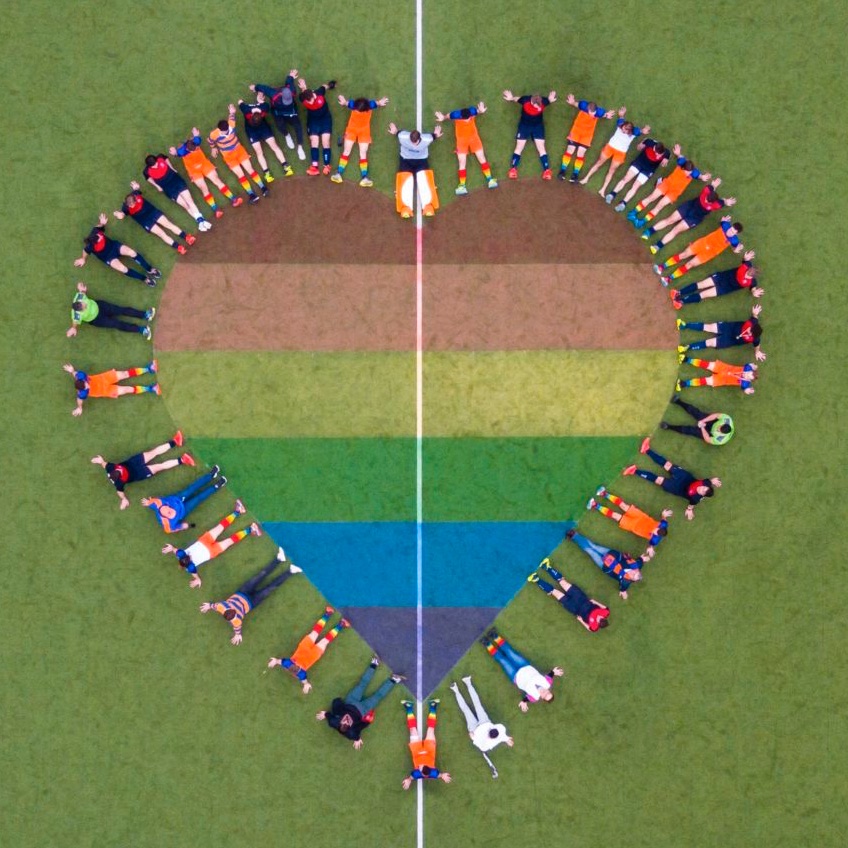
The Pride Cup now goes all the way up to the AFL. People would be familiar, having watched St Kilda Footy Club and the Sydney Swans play their Pride Cup, where the numbers on their backs are rainbows and the 50-metre arcs are rainbows. And then I would almost say Pride Cup’s crowning moment was the big love heart drawn on the commentary-box side of the Matlock field in 2019 for our Pride Cup round. And if you do jump on their website, it’s always the first image they show. Stacy, I might throw over to you, because I know that you were a huge part of that day in 2019 — handing out medals, and really were the face of the event.
Do you want to just talk to us about what Pride Cup means to you, and what that event was like from your end in 2019?
Certainly. Thanks, Tom. Yeah, look, so Pride Cup, as you mentioned there, was started out of a sporting club. So Pride Cup is actually a Pride Cup organisation — not-for-profit — and they help support sporting clubs around Australia to spread the message and be more inclusive and aware across different sporting codes. Now, they’ve come out of AFL backgrounds, they’ve moved into hockey, and they’re helping support so many other different sports.
And Hockey Victoria was strongly involved in Fair Go Sport in previous years, and they’ve really joined in partnership with Pride Cup to have their Pride Cup rounds as the key focus there — inclusion and advocacy and support. So, coming — I was still off on concussion leave, still can’t play, five years on, still can’t really play too much sport. But getting back involved with being around the club back in 2019 — Ed and Sophie put on this amazing event. It was Camberwell’s Pride Cup.
It was live-streamed by Hockey Victoria. We had this massive big love heart right in the middle. There were rainbow balloons. There were people. There were presentations. There were video recordings and messages from the day. For me, even not as a player, it meant so much. And I was actually approached by the club to say, “Hey, look, do you want to present some medals? And maybe you want to say something while you’re out there as well.” And I just sort of — I guess it relates to how much I love the club, and how much the club really does support all sorts of people, and how they want to try and help get their message across.
And like you said there, that love heart — that aerial photo that was taken of the Premier League teams around the edge — that’s been used around Australia. Not just by the Pride Cup organisation, not just by us, not by Hockey Victoria, but that message has been out there across various different websites and teams, and so many other sports who have also put love hearts out since then, and that sort of thing. So it really puts the message across of how much a simple little thing like a rainbow love heart on a pitch can make a difference — not just for where you’re standing, but so broadly as well.
I was certainly lucky enough to play that weekend, and it’s one of my fond memories. I think the photos of running across the love heart in the rainbow socks — it is something that really will stand out to me personally for a really long time. And that whole weekend was just incredible, and I’m certainly looking forward to being a part of it all again this year, and for many years to come. Now, we touched earlier just briefly on education and how we might be able to help inclusion grow within our club.
So obviously Camberwell is a club that puts a lot of effort into our inclusion, and particularly with the Pride Cup, which is coming up again this weekend. Stacy, I know that there are differences between clubs that do get involved in this space and clubs that don’t. Do you want to talk us through and explain a little bit about the differences between those two sorts of clubs? Certainly. Hockey Victoria, working with Pride Cup, does run some Pride Cup 101 events — workshops back in 2019.
We had another one again recently. That’s a big question people often ask: how do I do something for Pride Cup? How big does my event need to be? And really, it doesn’t have to be a major event. It’s just about starting to have those conversations, starting to share awareness around sexual and gender diversity and bits and pieces, and saying that it’s okay to be your true self.
And Hockey Victoria — we’re running our Pride Cup this weekend. The Hockey Victoria official round is over at the end of July. We don’t have any major home games on that weekend; we have it the weekend before. But this year, Pride Cups have been celebrated across hockey clubs over about four different rounds, because they all wanted to do something themselves on their home pitch. Two years ago, it was just a couple of clubs on the Pride Cup round weekend. Next time around, we’re talking about something that’s been run over four different weekends. That’s how much of a difference starting those conversations has really made.
And many clubs have been reaching out — not just hockey, but other organisations as well. But talking about hockey, clubs which don’t normally have champions in this sort of area have reached out to Hockey Victoria and others to say, “Hey, how can we do more things? What can we do to get involved? Or what should we do?”
Which says a lot — that we know we may not be doing much, but what can we do? Which says a lot to those that may be interested or are involved in hockey. And it’s not just about the players. It’s about the officials. It’s about the spectators. It’s about the admin people, the people that stock the beer up on Premier League weekends, and all those important things.
A sporting club is not just about athletes. It’s everyone. It’s a whole community. I think that’s really where we can see a huge difference just in these past two years — what Pride Cup is making across hockey.
Yeah, absolutely. And I think the difference is really clear. And even the fact that we can have a podcast like this that will hopefully start conversations is such a big step in the right direction, because it is something we talk about a lot — particularly in a sporting sphere — the inability that people have to talk about inclusion.
I can speak from experience. A lot of the time I used to get worried about speaking about inclusion, and particularly LGBTQ inclusion, because I was scared to make a mistake and say the wrong thing, and use the wrong acronym, or use someone’s wrong pronouns, or whatever it might be. And I think, in the position that I’ve been in, and fortunate enough to work in the space a little bit now — I’ll keep making mistakes. And from my end, as more of an ally in this space, my recommendation to people is: be willing to make a mistake on your quest for learning, because it’s the only way we will advance this at all.
I probably make a mistake half the time I speak about this, but I’m willing to learn, and I will aim not to make that same mistake again.
Julia, you keep reminding me in all of our meetings that you’re much younger than I am. So you’ve got the networks in the younger community. What sort of recommendations would you have to your friends, or your family, or your teammates, or the boys and girls who come up and grab a beer on Premier League weekend? How can they get better at this? What sort of initiatives can they do, and where can they learn, and things like that? What would your message be to those people? I think for me, a big thing — a really important step — is normalising asking people’s pronouns.
Because sometimes it gets misconstrued as, oh, that’s only for trans people. But it’s not. Everyone has pronouns — that’s how the English language works. And someone’s gender expression is very fluid. Gender is very fluid for a lot of people, and someone’s outward expression doesn’t necessarily align with how they identify. So I think just getting used to saying your pronouns in your email signature, or in conversation when you meet someone, or in your Zoom meetings, is a really good step, to show that you’re an ally and you care, and you’re trying to learn.
I think it’s difficult, but you have to try and not be afraid of getting people’s pronouns wrong. I think most people are happy to correct you if you’re obviously trying to learn how to do it, and be respectful.
From my experience, that’s a really easy little thing that people can do. Zoom added a new feature recently where you can put pronouns in, so they show up next to your name. I think just stuff like that is good, because it’s not a lot of effort, but it’s a really valuable way to show that you care and you’re interested in learning, and you support people. And just having cisgender people do that shows a lot of support and solidarity, and really helps normalise it. Using your privilege as a cisgender person helps normalise it and support gender-diverse and trans and non-binary and gender-fluid people. So I think that’s a good thing to do.
I might jump in there as well, Tommy, if that’s all right. One thing I think might be helpful — I don’t know — but I work as a GP, so I encounter a wide variety of patients. And one thing I’ve taught myself to do when I’m meeting a new patient is to not assume anything in regards to gender or sexuality. So I won’t necessarily use pronouns for partners or anything until my patient brings that up themselves. You can use a gender-neutral pronoun until they use a pronoun themselves, so you’re not assuming anything. And that’s something you can do in general conversation with anyone.
And I think most people — as Julia said, if you make a mistake, and as Tom said as well, if you’re trying — people are going to be happy to correct you. But if you assume, then sometimes, by assuming, you’re placing judgment on what you think it should be, and that can cause more harm. I think it’s safer to just not assume anything, and keep the conversation open as much as you can.
So, as the CHC Pride Committee focuses quite heavily on the LGBTIQA+ community — one of the really big elements of inclusion and how people identify is their pronouns. Now, I use the pronouns he/him. But Stacy, can you just talk us through exactly — for those who are completely unaware — what pronouns are, and the importance of them? Certainly. So, as we all — society, especially Western society — always seem to have genderised things. It was generally the binary gender of male or female, man or woman, husband or wife, ladies and gentlemen. But many cultures have never always had a binary system. As we all know, generally we talk about “his” or “hers”, that type of thing. But as people evolve — and we’ve been talking about the LGBTI community — over the past few decades, it’s really about what people self-identify as. Now, besides the traditional he/she, him/her, his/hers, that sort of thing, we often use the word “they”, both singularly and plural. Quite often “they” is also used as a pronoun for an individual: instead of preferring to be called “she” or “her”, they might be called “their” or “theirs”. Now, for me — I’ve been living now for over 10 years as my true female self, but I knew from the age of four that the gender I was being raised as wasn’t right. But it wasn’t until I was 36 that I found the strength to live as my true self.
But for me, I sort of grew up as — well, I’m a girl, I’m raised, I’m living as the one I’m expected to be, but I really knew, deep down inside, I’m female. So when I found the strength to come out and start living my life as my true self, I always thought, well, I guess I’m “she, her” — that’s my pronouns. And as myself, I even just saw the world as a binary world, and that’s the way the world was. So I even had to do my own understanding, and go through my own learning experience: well, actually, it’s not a binary world. And those that live their life as the gender that was assigned to them at birth — because a doctor saw what that baby looked like, so that’s what they assumed the gender of that person is.
Those that connect to the gender that was biologically theirs — a cisgender sort of person.
For me to come up in that world, I had to learn that actually it’s not binary. There are other differences. Some people are non-binary, so they don’t identify as either male or female. Or, if we take gender-fluid people, I might feel a bit like — from one side to the other at different times. So actually, through this journey of the last 10 years, I sort of realised that I do identify as “she, her”, but also “they”. I think that’s a bit of a recognition of my journey, where I’ve come from. And at times I’m a little bit gender-fluid: not quite female, but definitely not as I was raised.
And it’s just through those learnings that the pronouns make a huge difference. And it’s just asking the question: what are your pronouns? Rather than just having a tick-box of Mr, Mrs, Miss, it’s: who does an individual identify as? And that’s what it’s really all about — authentically, who is this person? How do they identify? Yeah. And I think that’s obviously an excellent answer, Stacy. I’d recommend a lot of people listen to that a few times, because it gives you a really good insight into pronouns and how they represent people.
From my end, I’m an ally trying to learn my way through pronouns and who people are, and questions are the best way to understand that. And the next thing is just not to assume. So just because you might assume that someone looks the way that a “he, him” or a “she, her” should look — don’t assume that those are the pronouns they go with, because assumptions are really dangerous. So if I can just recommend to everyone out there: ask questions first, and don’t make any assumptions. Assumptions are a gender-diverse or transgender person’s worst nightmare.
Phone calls and other bits and pieces — being misgendered so many different times because of how one looks, or how one sounded over the phone. It’s like, oh, it hurts. There’s this mental anguish inside. It’s like, oh no, that’s not me. This is who I am. So just because of the way someone looks, doesn’t mean you make assumptions. So ask, or use gender-neutral pronouns for them: “Hi, how are you?”
Or, “How is everyone today?” You know — “welcome”, that sort of thing. Yeah. And I think in a sporting space — and I know, Julia, you definitely want to add on this topic as well — in a sporting space, something that we get caught up doing a lot, and something that you wouldn’t often think about, is when you stand in front of your team and you go, “Hey guys, what are we doing today?” Or if you’re working in a boys’ or a girls’ team, we use those pronouns just really generally.
Just take a minute, think about what you’re saying — and there are plenty of options out there. Now, Julia, did you have something to add to this?
Sort of briefly, on what Stacy said about the assumptions. I think sometimes there’s a misconception that, oh, we only need to ask the pronouns of someone who’s come in in fishnets and a feather boa — like, they’re very obviously a bit extravagant, the stereotype of gay people, essentially. I think it’s really easy to fall into that stereotype of what an LGBT-plus person should look like. And I think it’s really important to remind yourself that that’s not the case.
Like, all the time. And that’s just about being respectful for people, as Stacy said — not making assumptions. Like, for example, I’m dating a man. That doesn’t necessarily mean that I’m straight. And I can wear a skirt — that doesn’t mean you identify as a woman, or that you are a woman. That’s a great point there, Julia, especially about sexuality. But we’ve talked a fair bit about gender and pronouns; in the context of sexuality…
You know, it’s not just about the traditional heterosexual sort of relationship. We’re also talking about someone that’s attracted to their own — someone that identifies as their own gender as well. Or they might be attracted to someone of multiple genders — not necessarily at the same time, but it’s more fluid. Or they may not necessarily actually be sexually attracted to anyone of a particular gender at all. So we talk a fair bit about the pronouns and what people identify as, but sexuality is another thing as well. So that was a great comment there, Julia. On the “come on girls” or “come on guys” comment in the sport…
I don’t know if I’m the best placed to talk about this, as a cisgender woman, but I think, as Tom said, it’s important to reflect on why that’s your assumption — that everyone else in the team also identifies as such. And where possible, it is nice to try and use more gender-neutral language, and just reflect on your assumptions of binary-gendered sport, and why that’s the default, especially in sport.
But I think it’s a good way to open up that conversation with the team, and with people, about how people feel about that. I’m certainly guilty of, you know, “come on guys, come on girls” — I do that still, because it’s just ingrained in you that that’s what you say. But I try to acknowledge and reflect on the fact that that’s how I’ve been conditioned to think by a heteronormative, cisgender society.
So I think just reflecting on that is important. Probably having a conversation with your team, if people are comfortable or uncomfortable with it. Obviously I can’t speak to that experience fully as a cisgender woman, but I think it’s an important reflection point. And that’s a great point, because hockey is traditionally a binary-gendered sport — there’s a male or female competition. And with Hockey Victoria, and I’m sure with Hockey Australia, the policies are now that, yes, it’s a binary-type gendered sport; however, you sign up for the competition which best represents the gender that you identify as. And I think that’s amazing leadership from above, to help give direction for clubs and existing players and things. It’s not about you joining a male or a female competition — you are joining a competition that best represents you, irrespective of the exact gender that you actually identify as.
You know, as a Pride Committee — as much as Camberwell does amazing things, that’s still something that we can do more of, and do more work with clubs, with the captains, with the teams, with the coaches, about how best to address the group during trainings, during game day, and those sorts of things, so that we are more inclusive. Because just remember: not everybody is out about their sexuality or gender.
They may not be able to, for various reasons, or may not feel comfortable within your particular club or workplace environment, because you’re not sure how it would react. So just being more inclusive is going to make them feel more comfortable, and there are health benefits, even though you may not know it. So there are all those great little tips and things.
Great points, and so much good information in there. So hopefully that certainly helps a few people out over their journey, over the remainder of this season and moving forward as well. My recommendation, as I say, as a budding ally in this space, is just: consume as much information as you can. Learn things, because it’s an ever-evolving role, being an ally and being within the community. And the more information you have, the better you’re going to be at it. I was thinking earlier on, what would tips be — well, if I could give a couple of tips to people who want to be allies in this space, and hopefully a podcast like this can open up those doors and these conversations.
And my top three tips for anyone that wants to be an ally: the first one would be to have a conversation, ask questions, because it’s better than nothing, and you’re only going to get better and learn more. The next tip would be to help educate those other people who might want to be allies. So when you learn information, share it with others — help them out, help them be better at this. And then the last one — and this is particularly prevalent in sport, not so much hockey, but just sport generally — is to call out behaviours that are harmful. I think, as a potential ally, that’s probably one of the most powerful things you can do: stand up to a friend. It can be incredibly uncomfortable, but no one will learn if we collectively don’t call these behaviours out.
So look, we have a real hope on the CHC Pride Committee here that we can help educate our club to become more inclusive. I think we’re terrific in this space already, but it’s a never-ending cause — we’ll never clock inclusion. So I’d love to say thank you to Julia, Sam and Stacy for your time this evening. As always, if you’ve got any questions about it, you can reach out to any of us. Thanks a lot, everyone, for joining us tonight.
It’s been awesome.
You’ve been listening to the Camberwell Hockey Podcast. We’d like to send a big thank you to our hosting team, our guests, and you, the listener, for your support. If you enjoy the show, please give us a review on iTunes, or wherever you get your podcasts. This show is recorded and produced by Camberwell Hockey Club in Melbourne, Australia. If you have any feedback, comments or questions, please find us on Twitter at Camberwell underscore HC. You’ll receive more information on our website at camberwell.hockey.
See you next week.